
What does the Zero Knowledge Proof Actually Do?
Four Methods of Sending ZEC
On-chain and Off-chain Transactions are separate Concerns.
How Are Coins Transparent?
What about the Company behind Zcash?
Impact on Indian Users
FAQs

In 2016, Zcash was launched with a unique feature of shielding transaction details. However, the public ledger is still the more utilized ledger. The public ledger shows what the users of the network want to disclose. Price charts do not illustrate the gaps between what a blockchain is capable of and what is utilized by the users of the blockchain.
Zcash (ZEC) is a cryptocurrency similar to Bitcoin, but with additional security features that enable privacy and anonymity. The ZEC blockchain uses zero-knowledge proofs to provide a mathematical way of proving ownership of a particular amount of coins without disclosing other information. The proof is accepted by the blockchain, and the transaction is finalised. Zero-knowledge proofs keep all information involved in the transaction private.
Zero-knowledge proofs keep the information involved in the transaction private and have numerous off-chain use cases. For example, using zero-knowledge proofs, a person can be mathematically proven to be above the minimum age required for entry to a bar without disclosing their name, address, or date of birth to the door person.
Zcash supports transparency, and therefore enables users to choose between private or public transactions. Transparent addresses start with t1 or t3 and work similarly to transactions on the Bitcoin blockchain, while private transactions are protected by zero-knowledge proofs. Private transactions can be further divided into more private transactions based on the amount of information disclosed.
| Sending from | Sending to | Common name | What the public ledger shows |
|---|---|---|---|
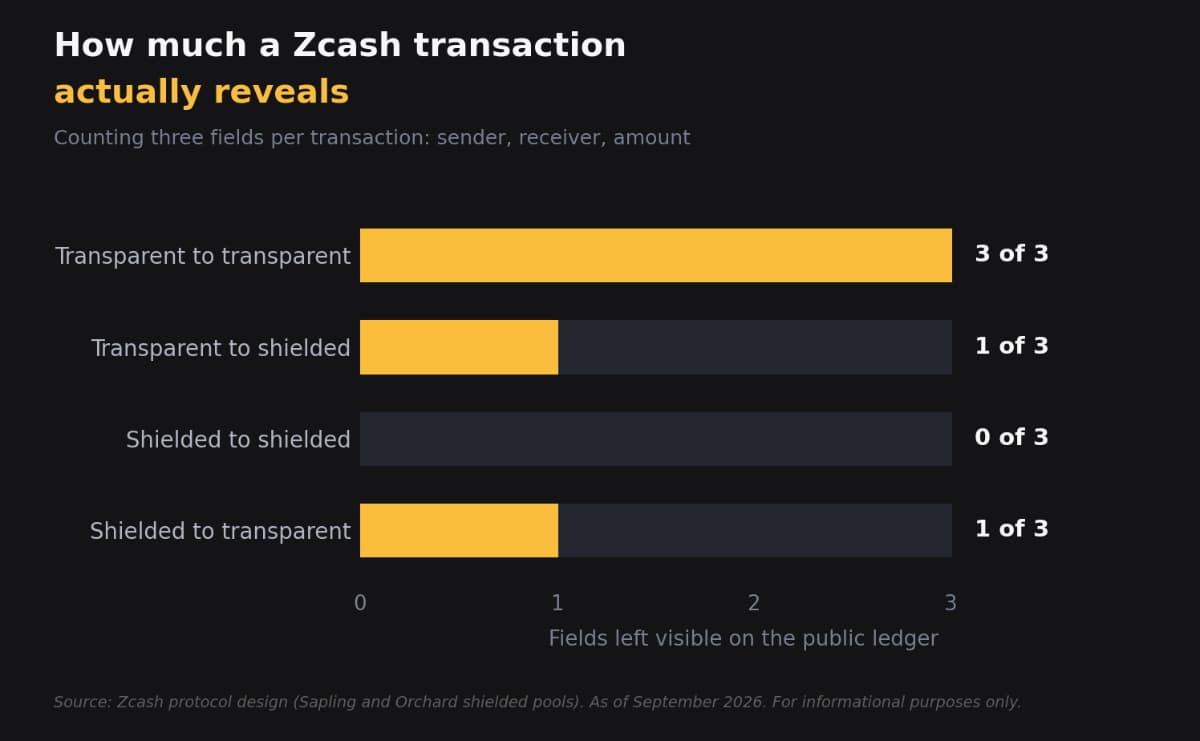
| Transparent | Transparent | t to t | Sender, receiver, and amount |
| Transparent | Shielded | Shielding | Source address and amount going in, destination hidden |
| Shielded | Shielded | z to z | Only that a transaction happened, plus the fee |
| Shielded | Transparent | Deshielding | Destination address and amount coming out, source hidden |
Source: Zcash protocol design, Sapling and Orchard shielded pools. As of September 2026.
The chart below counts the same thing numerically. Every transaction carries three fields that can be exposed: sender, receiver, and amount, and the bars show how many stay public in each case.
Generally, on-chain transactions involve the ZEC blockchain, and off-chain transactions do not. Off-chain transactions include a centralised exchange moving ZEC between two of its customers. In this case, the exchange doesn't involve the ZEC blockchain.
Sounds private, but the exchange ultimately controls the coins and can access all info about the transactions and users from KYC. There is no cryptographic protection for you until you possess the coins and use a shielded address.
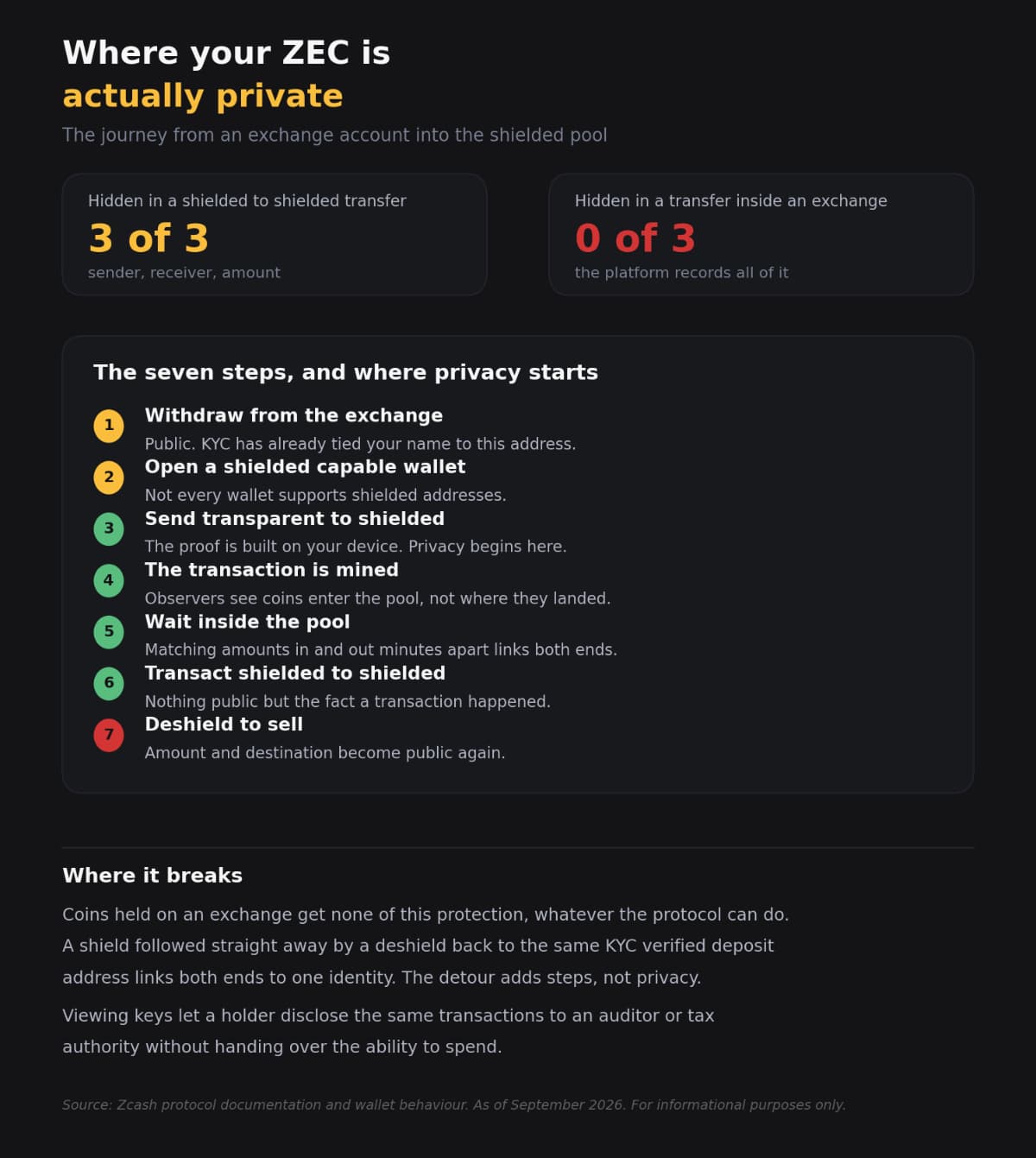
There are two main behavioral factors that impact shielding: the time of the transaction and the address that the coins are transmitted to.
Because of the behavioral factors at play, it is possible for coins to be transparent even though a shielding transaction was processed. It is also possible for coins to be transmitted to a shielded address even though there was no shielding transaction. Because of this, determining if coins are transparent or shielded can be complicated.
Which Exchanges Support Shielding?
Not all exchanges support shielding. Some do not allow deposits from shielded addresses. Make sure to check the rules of an exchange before sending shielded coins. Only a handful of wallets support shielded addresses to begin with, among them Zashi, Ywallet, Zingo, and Nighthawk.
The Electric Coin Company, founded by Zooko Wilcox, created and launched the Zcash blockchain and built the Zcash wallet, Zashi. The Zcash Foundation, a different company, created a second implementation of a Zcash node, Zebra. Other companies and developers receive grants to work on Zcash and Shielded Transactions from Zcash Community Grants. Shielded Labs is also working on the planned move from mining to staking. The community decides how the block rewards are allocated, and the most recent negotiation occurred at the NU6 upgrade in November 2024.
Two updates impact Indian users the most. The first, known as NU5, launched in May 2022. This update introduced Zcash's first shielded transaction pool, known as the Orchard. This update also unified users' shielded and transparent addresses. This means users no longer have to decide which type of address they want to use. NU6, released in November 2024, implemented the second halving and adjustments to the current funding system.
Shielding has no effect on your income tax liability. The Indian government has enacted legislation, which is a part of the Income Tax Act, to impose a flat 30% income tax on profits derived from the sale of Virtual Digital Assets (VDAs) under Section 115BBH, and to provide that exchanges are obligated to withhold a 1% TDS on the sale of VDAs under Section 194S. Furthermore, the loss from the sale of a VDA cannot be set off against the gains from the sale of another VDA. It is also worth mentioning that, as of the date of this writing, cryptocurrency exchanges operating in India are required to register with FIU-IND as reporting entities under PMLA. This means that, regardless of the transactions on a given exchange, the initial and final points of the cryptocurrency transactions are fully known and identified.
From a tax compliance perspective, a "viewing key" can be issued to a chartered accountant, auditor, or tax authority to give them the ability to view a holder's transactions without granting any ability to spend. Confidential is not the same as hidden, and neither is the same as exempt.
One risk worth pointing out is that several jurisdictions and exchanges have delisted or restricted privacy coins on anti-money laundering grounds, including forced delistings in Japan and South Korea. That pressure remains a live regulatory risk for ZEC specifically, separate from ordinary price volatility.
India Crypto Research operates independently. The information presented herein is intended solely for educational and informational purposes and should not be construed as financial advice. Before making any financial decisions, it's essential to undertake your own thorough research and analysis. If you're uncertain about any financial matters, we strongly recommend seeking guidance from an impartial financial advisor.


