What CARF actually does
A global web, switching on in phases
India's own homework is already done.
The evasion problem India is trying to solve
Where the AI comes in
What it means if you hold crypto in India
The Takeaway

CARF is a global rulebook for crypto tax reporting, which requires crypto exchanges to report their users' trades to tax authorities, who then exchange the information automatically with each other.
Approximately 76 jurisdictions have committed to CARF, and many plan their first exchanges in 2027. India's international exchange date is only reported, not confirmed, so check the latest OECD records.
India is taking no chances. Since 1 April 2026, user-level reporting of crypto transactions has been mandated by Section 509 of the Income-tax Act, 2025, with penalties for reporting entities that file late or inaccurately.
There is a real problem of tax evasion. In August 2025, the government said it had identified about ₹630 crore of undisclosed crypto income and sent out over 44,000 notices.

 Part of a series
Up to now, the real issue with taxing crypto has not been the tax rate. It has been visibility. Shares and bank accounts have intermediaries that report to the taxman. But a coin bought on a foreign exchange, moved to a wallet, and sold peer-to-peer for cash could be completely invisible to the tax system.
This is the gap that the Organisation for Economic Co-operation and Development (OECD) is filling with the Crypto-Asset Reporting Framework (CARF). For India, with its 30% tax and 1% TDS, this could not have come at a better time.
CARF is a standard for the automatic exchange of tax information on crypto-assets, developed by the OECD and the G20. It is more of a structure for legislation and is not a law in itself. This means that each country adopting CARF has to enact local legislation based on CARF's structure and incorporate it into its legal system.
Once this is done, Reporting Crypto-Asset Service Providers, as defined by CARF, have to determine which crypto-assets are in scope, identify their users and where those users pay tax, and report relevant transactions to the tax authorities on an annual basis.
In practice, that means centralised exchanges, brokers, dealers, custodial crypto wallets and crypto ATM operators are in the net, as are some DeFi intermediaries. Reportable transactions include crypto-to-fiat and crypto-to-crypto trades, large retail payments, and transfers such as airdrops and staking rewards. Non-custodial wallet software and pure peer-to-peer protocols are not included.
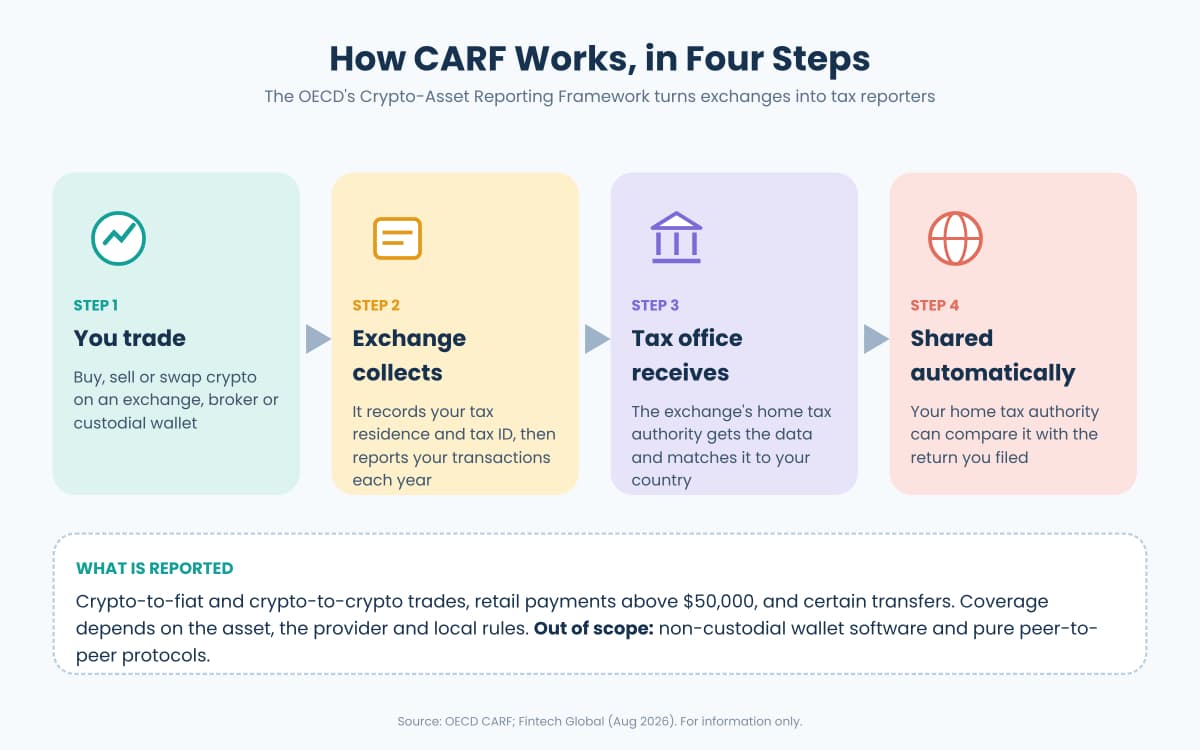
Infographic 1: How CARF works, in four steps
Implementation is happening in phases. Fintech Global's August 2026 update reported that approximately 76 jurisdictions have committed to CARF. Around 46 of those, including the UK, all 27 EU member states, Japan, Canada and Switzerland, plan their first exchanges in 2027. Approximately 29 more, such as Singapore, Hong Kong and the UAE, follow in 2028, and the US is targeting 2029, bringing the total to 76. These are planned first-exchange years, not a count of live exchange relationships, and not every committed country will start swapping data at the same time. The US also has its own broker reporting on Form 1099-DA from 2026 transactions.
This is important for Indian investors, because many of the popular offshore investment routes go through these jurisdictions. A trader who moved their profits to a foreign exchange would usually assume that no one back home would know about it. CARF is designed to remove that assumption.
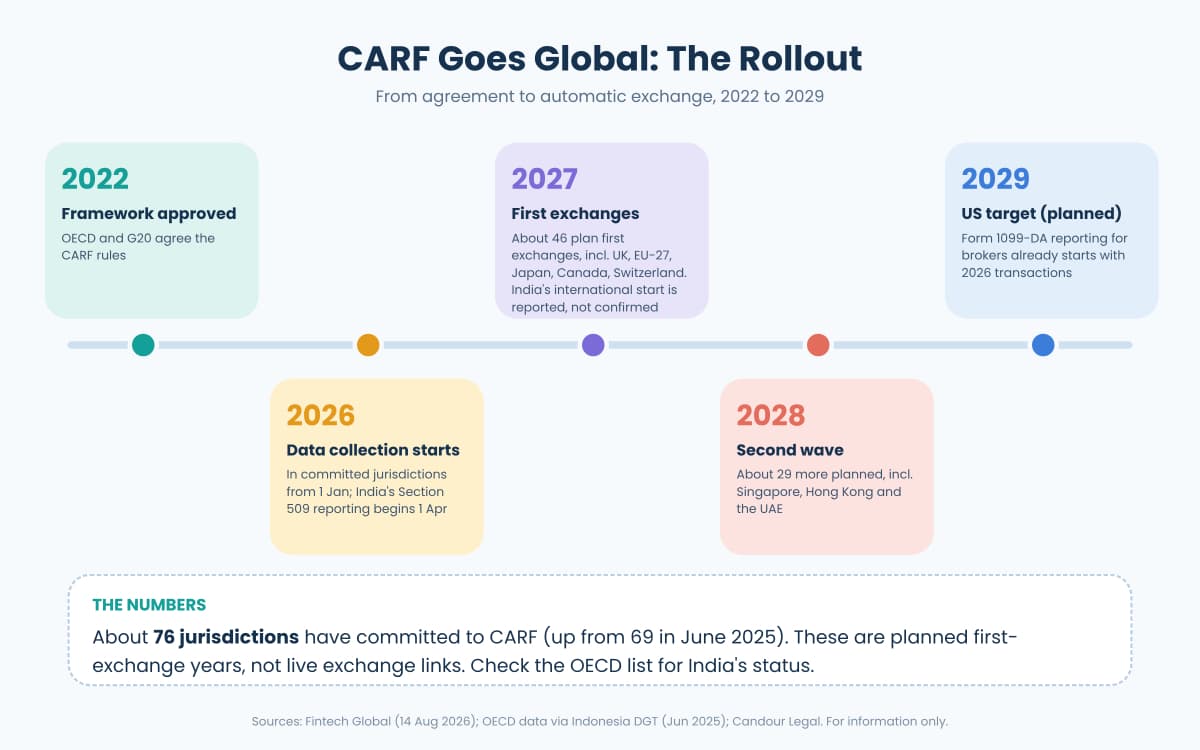
Infographic 2: The CARF rollout, 2022 to 2029
There is a part that many people miss: India has not just been waiting for CARF. Section 509 of the Income-tax Act, 2025, which re-codifies Section 285BAA inserted by the Finance Act, 2025, has required prescribed reporting entities to report user-level crypto transaction details since 1 April 2026. Under Rule 242 of the Income-tax Rules, 2026, a reporting crypto-asset service provider must comply if it has a specified link to India: Indian tax residence, Indian incorporation or legal personality, management from India, or a regular place of business in India. Transactions effected through an Indian branch are also covered, and there is relief from duplicate reporting where the provider already reports under a partner jurisdiction. In clear terms, an offshore exchange is not automatically covered just because Indian residents use it.
The penalties are designed to be felt. As summarised by Candour Legal, not furnishing the statement attracts a penalty of ₹200 per day, while inaccurate information that is not corrected, or a failure of due diligence, can cost ₹50,000. In March 2026, the rules were also amended so that crypto-assets count as financial assets for CRS, the older standard for the automatic exchange of bank account information.
In August 2026, the CBDT issued a guidance note operationalising India's CARF reporting under Section 509, read with Rules 241 to 244 and Form 167 of the Income-tax Rules, 2026. KPMG notes this covers identification of reporting providers, determination of tax residency, self-certifications and the handling of cross-border transactions. On exchange of information with other countries, a Finance Ministry official told Business Standard in September 2025 that India would begin on 1 April 2027 and was expected to sign the multilateral competent authority agreement for CARF during 2026. In the same report, a partner at Khaitan & Co stated that non-disclosure of foreign crypto could attract tax demands, penalties and prosecution under the Black Money Act, 2015, and that CARF data would let the authorities cross-check what people declare. One legal analysis noted that as of late 2025, India was not on the OECD's published lists of committed jurisdictions, so it is prudent to confirm the latest status before treating 2027 as settled.
The government is fairly open about the size of the problem. On 5 August 2025, Minister of State for Finance Pankaj Chaudhary told Parliament that the CBDT had found undeclared crypto income worth around ₹630 crore (roughly $72 million), and that over 44,000 notices had been issued to people and entities that had not reported their crypto income, as reported by CryptoSlate and CCN. The notices covered 2022-23 and 2023-24, and around ₹705 crore had been voluntarily reported over the same period. According to CCN, the department found these cases by matching exchange-reported transactions against individual returns, looking for missing Schedule VDA entries and undeclared profits.
The next major development came in October 2025, when the Economic Times, via CryptoNews, reported that the tax department was looking into over 400 high-net-worth individuals (HNIs) trading on Binance for the period between 2022-23 and 2024-25. The focus was reportedly on peer-to-peer trades settled through local bank accounts, Google Pay, or cash. Since the details come from press reports and have not been officially confirmed, treat them with care.
The pressures are obvious. VDA gains are taxed at a flat 30% under Section 115BBH of the 1961 Act (now re-codified in the 2025 Act), plus cess and any applicable surcharge, with 1% TDS on transfers. Losses cannot be set off against other income. Some commentators put the highest effective rate at approximately 42.7%, but this depends on income level and tax regime and is not a universal figure. Industry figures argue that this structure pushes traders offshore. CoinDCX's CEO, Sumit Gupta, has said as much, though that is an industry view rather than a government finding. The tax department itself admits the difficulty. In a Reuters report of 8 July 2026, documents showed the department saying that fewer than a quarter of the 6,45,000 people who transacted in crypto in the year to 31 March 2023 reported it in their returns. It added that offshore exchanges, private wallets and rupee peer-to-peer trades make it difficult to identify owners and recover tax, and put India at about 39 million crypto traders holding roughly $2.1 billion. The RBI, meanwhile, renewed its lean towards prohibition and warned that stablecoins could make crypto gains harder to detect. The Reuters story did not mention CARF or AI.
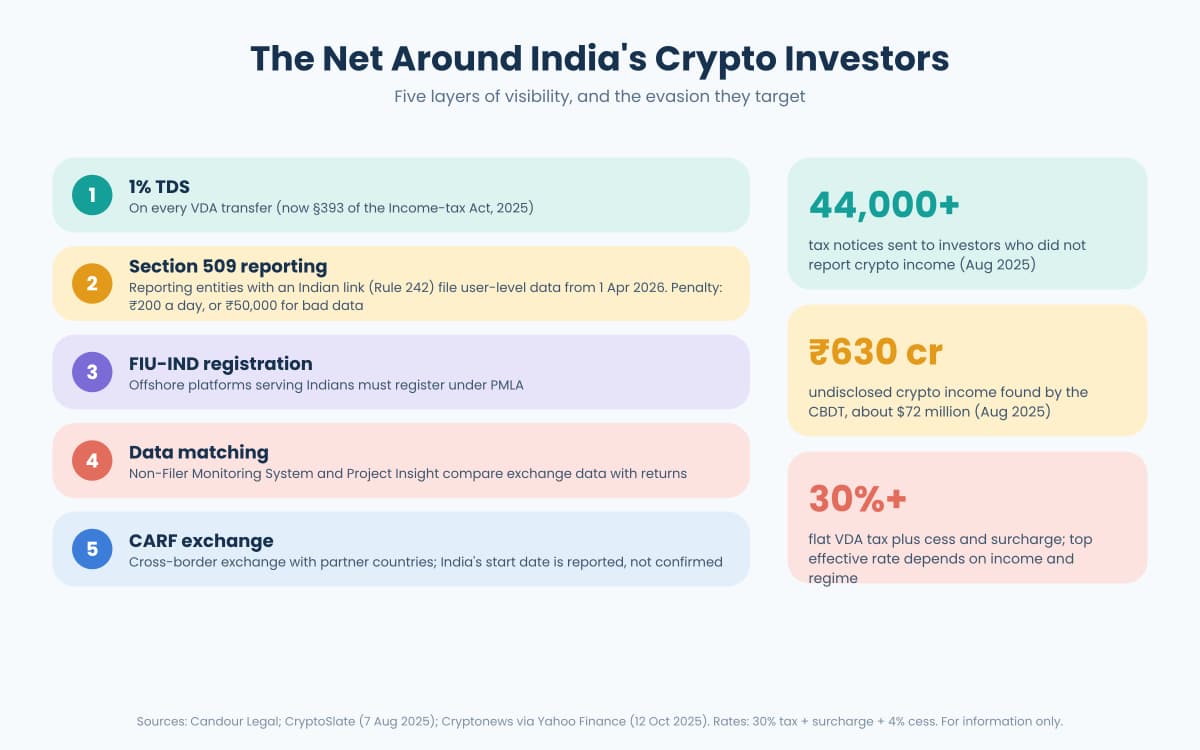
Infographic 3: The layers of visibility around India's crypto investors
No doubt you've come across articles on how India is using AI to catch crypto tax evaders. What does the public record really show?
According to Dig.Watch, the Income Tax Department uses machine learning and digital forensics to flag suspicious crypto activity, matching TDS data reported by exchanges against what taxpayers declare. CryptoSlate's August 2025 article names the actual tools: the Non-Filer Monitoring System and Project Insight, which cross-check transaction data against income tax returns and TDS returns filed by Virtual Asset Service Providers (VASPs). A CoinMarketCap Academy article attributes to CBDT Chairman Ravi Agrawal the statements that the Income Tax Department can view more than 6.5 billion domestic digital transactions, and that crypto tax data is shared automatically between countries. Since the article is undated and its collection figures do not add up, we treat it as indicative only. The CCN article describing the 44,000 notices credited Project Insight, the Non-Filer Monitoring System and the CBDT's NUDGE initiative for data matching, and did not mention AI at all.
There is a caveat. While the ₹437 crore of crypto tax collected in 2022-23 is frequently quoted in the same breath as the AI story, the sources do not show how much of it AI produced, and none of them name a specific AI product or says how many notices came from a model. So the honest summary is this: India is clearly using data matching and analytics, and CARF will feed it far richer data. But the claim that AI alone is catching evaders is plausible, not proven.
The OECD's own work points the same way. Its 2025 report, Governing with Artificial Intelligence, looks at 200 real-world examples of governments using AI, with fraud detection among the main benefits. A tax authority with clean, structured CARF data is exactly the kind of body that can make use of it.
• Report everything. Your Indian exchange is already reporting your transactions to the tax department, so your return should match what it files.
• Do not rely on offshore or P2P routes to stay invisible. Reporting platforms, data matching and, from 2027, international exchange are all closing those gaps.
• Keep records. Dates, values, wallet addresses and exchange statements make notices far easier to answer.
• Expect letters, not just headlines. The tax department doesn't only write to large traders; it writes to ordinary investors too.
CARF doesn't alter India's tax rate. It changes the odds of being found. Section 509 reporting is already in effect, the CBDT has issued its guidance, and an international exchange network is lining up behind it. The fairness of the 30% regime is a separate debate. What is certain is that the era of quietly hiding crypto gains is coming to an end.
Sources: OECD, Fintech Global, KPMG, Candour Legal, Business Standard, CryptoSlate, CCN, Cryptonews, Reuters, CoinMarketCap Academy, Dig. Watch, Indonesia DGT, IRAS Singapore
India Crypto Research operates independently. The information presented herein is intended solely for educational and informational purposes and should not be construed as financial advice. Before making any financial decisions, it's essential to undertake your own thorough research and analysis. If you're uncertain about any financial matters, we strongly recommend seeking guidance from an impartial financial advisor.