
India: Enforcement Over Legislation
United States: Regulators Move Without Congress
European Union: MiCA Is Live, But Already Changing
Steady and Predictable: Dubai
What This Means for the Reader
FAQs

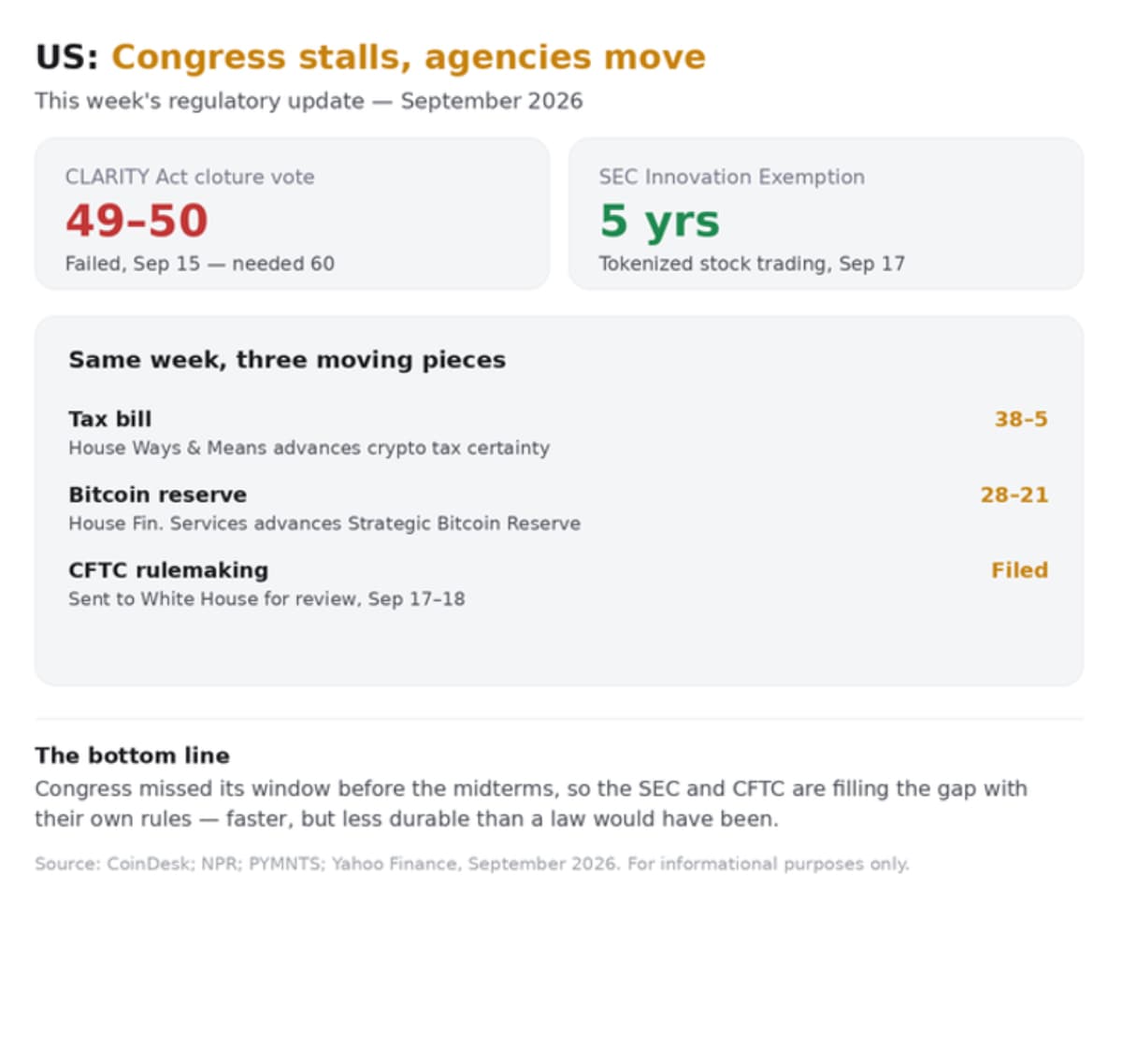
Four different regulatory scenarios played out last month. The biggest difference maker was likely the 15th of September session of the U.S. Senate. If just eleven more votes had been cast in favour of the CLARITY Act, it would have delivered the first-ever comprehensive legislative framework for digital assets in the world's largest economy, but it fell short 49-50. Meanwhile, just over a week before that, India's financial intelligence unit had already taken action against 15 offshore digital asset exchanges. As the U.S. and India presented examples of legislative gridlock and enforcement-led regulation respectively, the digital asset regulatory landscape in Europe and the UAE continued to evolve as well.
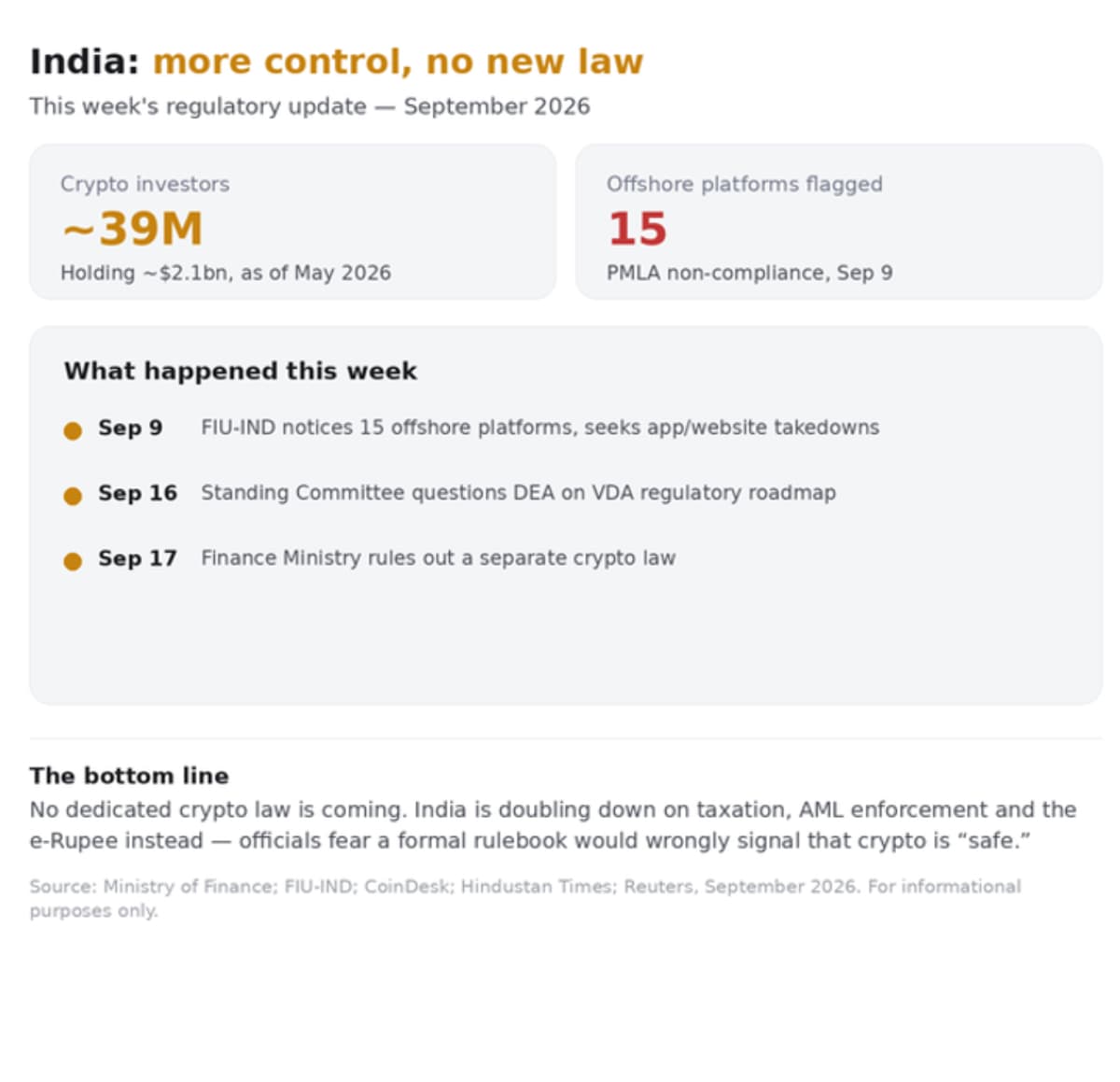
The focus of India's regulation of the digital asset space this month was the government's decision not to pursue a separate law. On September 17th, the Indian Finance Ministry told Parliament's Standing Committee that a dedicated law to regulate digital assets was not under consideration. Officials pointed to the Digital Rupee as the "safe" alternative and expressed concern that a formal regulatory framework for digital assets could create a false sense of security among investors, suggesting government backing where none exists.
This statement came two days after the Department of Economic Affairs (DEA) was questioned before the Standing Committee on where its VDA policy actually stands. Just over a week before that, the Financial Intelligence Unit (FIU-IND) had issued notices to 15 offshore cryptocurrency exchanges, including Weex, Blofin, Bitunix and Pionex, for operating in India without registering under the Prevention of Money Laundering Act (PMLA). Any crypto platform serving Indian users is required to register under the PMLA, verify customers and report suspicious activity, regardless of where it's based. FIU-IND asked for their apps and websites to be blocked outright, the same strategy that was used against Binance in 2024, which eventually led to Binance registering in India and paying a fine of ₹18.82 crore (roughly $2.23 million).
India's focus is clearly enforcement over legislation. With an estimated 39 million Indian investors holding around $2.1 billion in crypto, and fewer than a quarter of them actually declaring their gains at tax time, it's not hard to see why the government is leaning into enforcement rather than writing new law.
The most important part is what happened afterward. Within 48 hours of the CLARITY Act's failure, the Securities and Exchange Commission (SEC) rolled out a five-year "Innovation Exemption," allowing qualifying platforms to trade tokenised versions of US securities on chain without registering as full exchanges. The Commodity Futures Trading Commission (CFTC) also sent its own broad crypto rulemaking proposal to the White House for review. In effect, both agencies decided not to wait on Congress.
During the same stretch, two narrower bills kept moving: the House Ways and Means Committee voted 38–5 to advance a crypto tax certainty bill, and the House Financial Services Committee voted 28–21 to advance the bill formalising Trump's Strategic Bitcoin Reserve. The pattern is becoming familiar. Narrow, targeted bills keep gaining support, while the big comprehensive bill keeps stalling.
On July 1st, the final phase of the Markets in Crypto Assets (MiCA) framework entered into effect across all 27 EU member states. MiCA mandates uniform licensing and operating rules for crypto firms and sets out risk disclosure and client asset safeguarding requirements. But the framework being fully in force doesn't mean it's finished.
As of early July, only 244 firms had completed full authorisation as Crypto Asset Service Providers (CASPs), MiCA's licence category for exchanges, custodians and brokers. Brussels has already opened a consultation on what's informally being called "MiCA 2.0." The headline proposal is bringing non-EU stablecoin issuers into scope, largely aimed at US issuers riding in on the back of the GENIUS Act, alongside dedicated rules for tokenised deposits and payments.
There's also a push to centralise supervision of authorised firms under the European Securities and Markets Authority (ESMA) rather than leaving it scattered across national regulators. ESMA has separately kicked off a multi-year review, running into 2027, of how licensed firms are actually safeguarding client assets, a sign the EU is shifting from "get everyone licensed" to "make sure the licence actually means something."
Regulatory movement from VARA continues in its usual, undramatic way. VARA's updated Exchange Services Rulebook (v2.1) took effect on March 31st, and for the first time permits excha crypto derivatives, including futures, options and perpetuals, under a permanent regime, with controlled retail access rather than a blanket ban or a free-for-all.
It isn't acting alone, either. The UAE's federal Capital Markets Authority rolled out its own Virtual Assets Framework in April, expanding its regulated activities from three to eight, running in parallel with VARA's Dubai-specific rules rather than replacing them. VARA also published fresh AML/CFT risk assessment guidance in June. Altogether, the UAE now has over 80 licensed virtual asset service providers across its five regulators, and the emphasis has clearly shifted from "can you get a licence" to "can you keep it."
Four different regulatory postures from India, the U.S., Europe and the UAE, each reflecting a different regulator's approach. India and the UAE are steadily pressing ahead with enforcement and rule updates, while the U.S. and Europe are working around legislative gridlock through agency action and rulebook revisions.
The overall trend is clear: almost nobody is waiting for comprehensive legislation anymore. Regulation is showing up through whatever tool is already available: tax law, agency exemptions, rulebook revisions, licensing regimes. In these four markets, it's more likely a new rule will arrive as a tax notice, an agency exemption, or a compliance circular than as a headline-grabbing new law. Worth keeping an eye on which of these approaches actually holds up.
India Crypto Research operates independently. The information presented herein is intended solely for educational and informational purposes and should not be construed as financial advice. Before making any financial decisions, it's essential to undertake your own thorough research and analysis. If you're uncertain about any financial matters, we strongly recommend seeking guidance from an impartial financial advisor.


