What is a Stablecoin?
Who is Actually Behind It?
How Does It Keep Its Dollar Peg?
Where Can You Use It?
Who's Running This?
What's the Catch?
Why OUSD Matters
FAQs

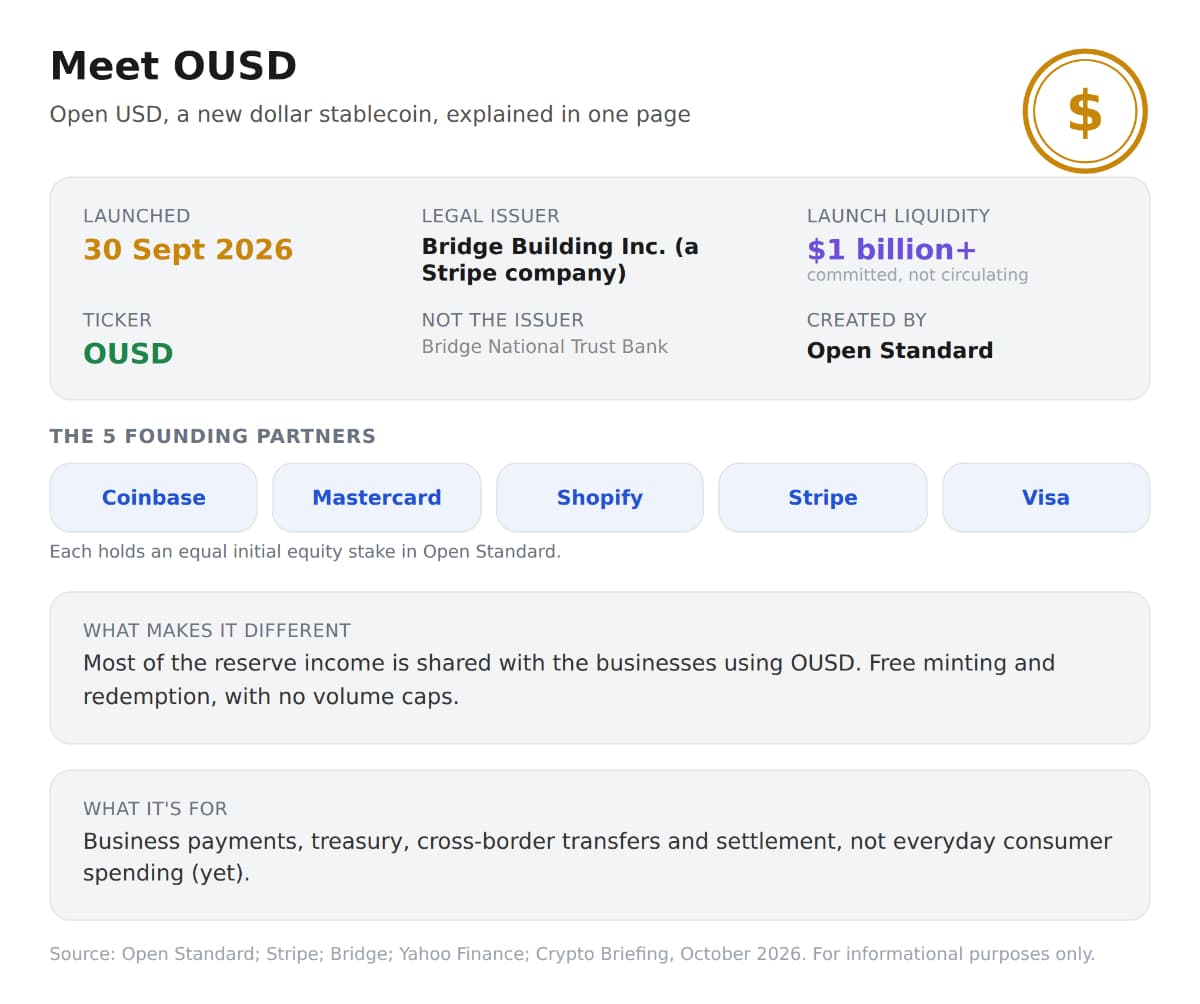
Open USD (OUSD) launched on 30 September 2026, backed by Coinbase, Mastercard, Shopify, Stripe, and Visa, with more than $1 billion in committed day-one liquidity.
Businesses that use OUSD have most of its reserve income shared with them. There are no fees to mint or redeem OUSD, and no volume limits.
Open Standard built it, the five founding partners funded it, Bridge Building Inc. issues it, and BlackRock, Lead Bank, and BNY hold the reserves.
OUSD runs on Base, Ethereum, Solana, and Tempo, and can be accessed through Stripe, Visa, Mastercard, and Coinbase.
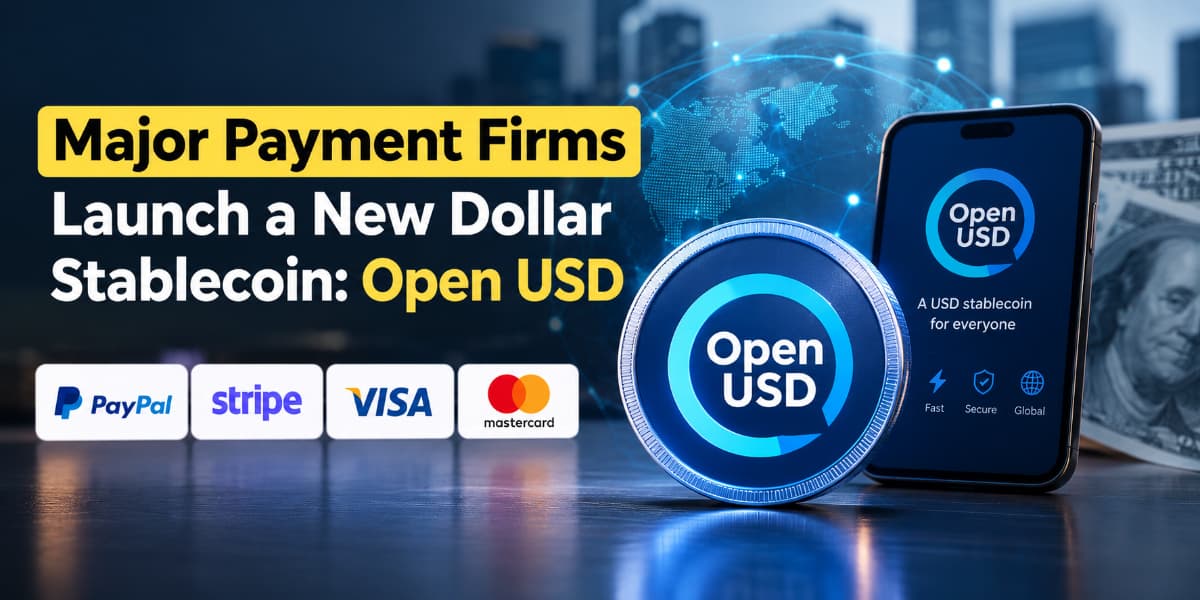
A consortium consisting of Coinbase, Mastercard, Shopify, Stripe, and Visa launched a US dollar stablecoin, Open USD (OUSD), on 30 September 2026. Here is the information about OUSD, explained in simple terms.
This isn't a scrappy crypto startup project. OUSD is a single new dollar stablecoin, run by a newly formed organisation named Open Standard and first announced on 30 June 2026. It launched with more than $1 billion in committed day-one liquidity. The goal of the consortium is to let real businesses, not just traders, move dollars around the internet as easily as sending an email.
As of now, banks handle most international wire transfers. OUSD aims to give businesses a faster alternative, moving dollars using blockchain technology.
Stablecoins are cryptocurrencies whose values are tied to traditional currencies, usually the US dollar. Stablecoins are far less volatile than cryptocurrencies like Bitcoin or Ether.
Stablecoins are used for cross-border dollar transfers, in a fraction of the time it takes for a traditional international wire transfer.
OUSD aims to be shared infrastructure for internet-native financial services: banking, cross-border payments, settlement, and institutional trading. Think of it less as one company's product and more as a shared utility that five giant companies built together.
Here's what makes it different from the rest. Traditionally, stablecoin issuers keep the interest earned on their reserves. OUSD gives most of the interest earned to the companies using OUSD, after a management fee. Also, OUSD doesn't charge a fee for minting or redeeming, and there are no volume limits.
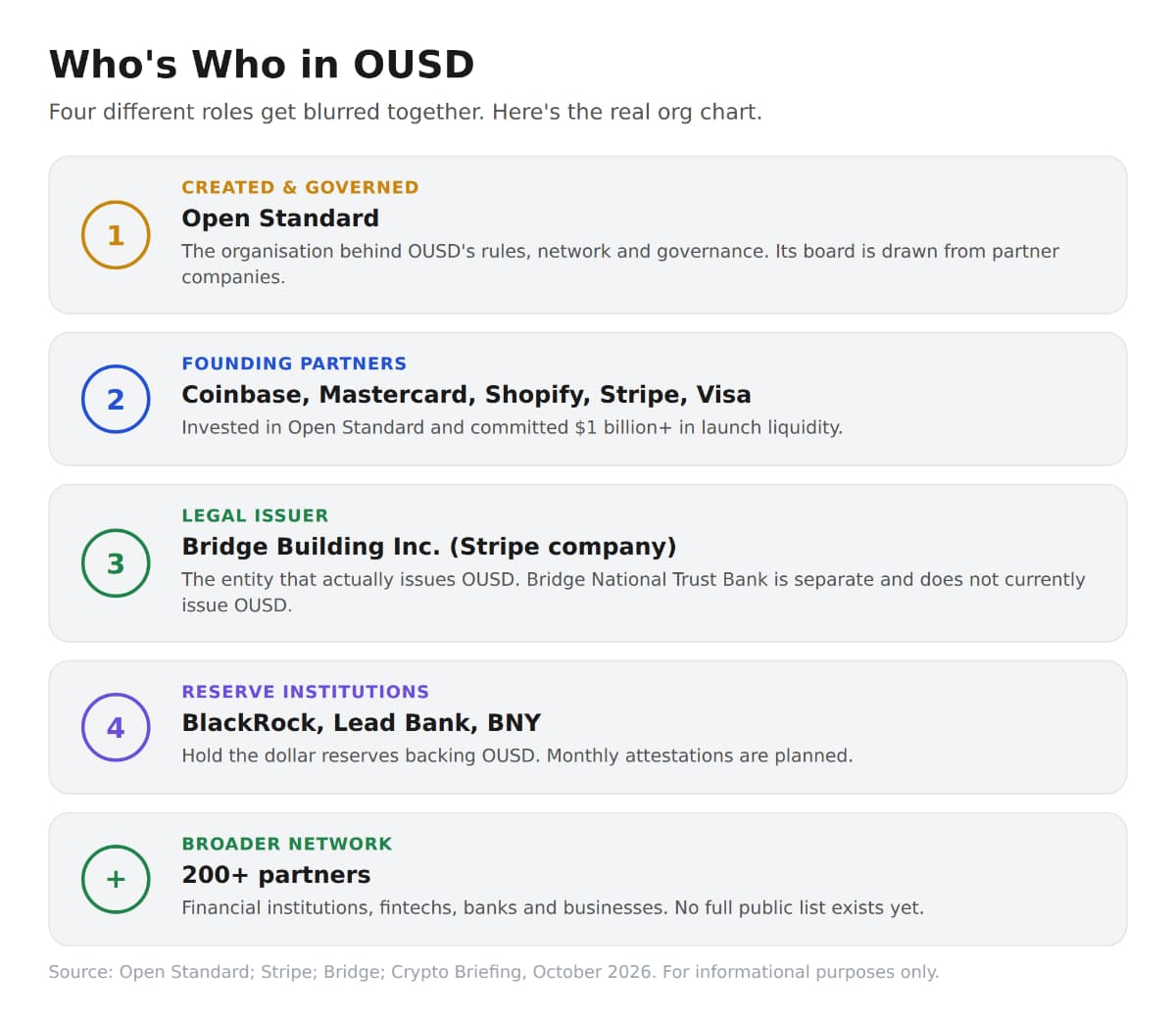
In the media, the word "backers" is often used to refer to everyone involved with the coin. However, there are four different groups.
The first is Open Standard. It created OUSD and oversees the rules of how it works. Its board is made up of partner companies, not a single corporate parent.
Next, Coinbase, Mastercard, Shopify, Stripe, and Visa, the five founding partners, each invested in Open Standard with an equal initial equity stake. Together, they committed $1 billion-plus in launch liquidity. However, none of them issues OUSD.
Stripe bought Bridge Building Inc. for approximately $1.1 billion in 2024. Bridge is the legal entity that issues OUSD.
Bridge National Trust Bank is a different legal entity from Bridge Building Inc. It is not operational yet and does not currently issue OUSD, despite the similar name.
Finally, the dollars backing OUSD are held by BlackRock, Lead Bank, and BNY.
Open Standard says its network includes over 200 financial institutions, fintechs, banks, and businesses. However, it hasn't published a full public list, so it's more correct to call these companies network partners, not investors or backers.
OUSD runs on a simple 1:1 model. Businesses can create (mint) or cash out (redeem) OUSD at exactly one US dollar per token. Businesses can do this for free through OUSD's supported partners.
OUSD's reserves are held by BlackRock, Lead Bank, and BNY. Open Standard says it will publish monthly reserve attestations, independent confirmations that the reserves are really there, through Bridge's reporting system.
It is important to understand that holding reserves, issuing the token, handling redemptions, and governing the network are four different jobs, done by different parties. Price risk is reduced by the dollar peg. Other forms of risk, including operational, legal, liquidity, and counterparty risk, are still present, as with any new financial product.
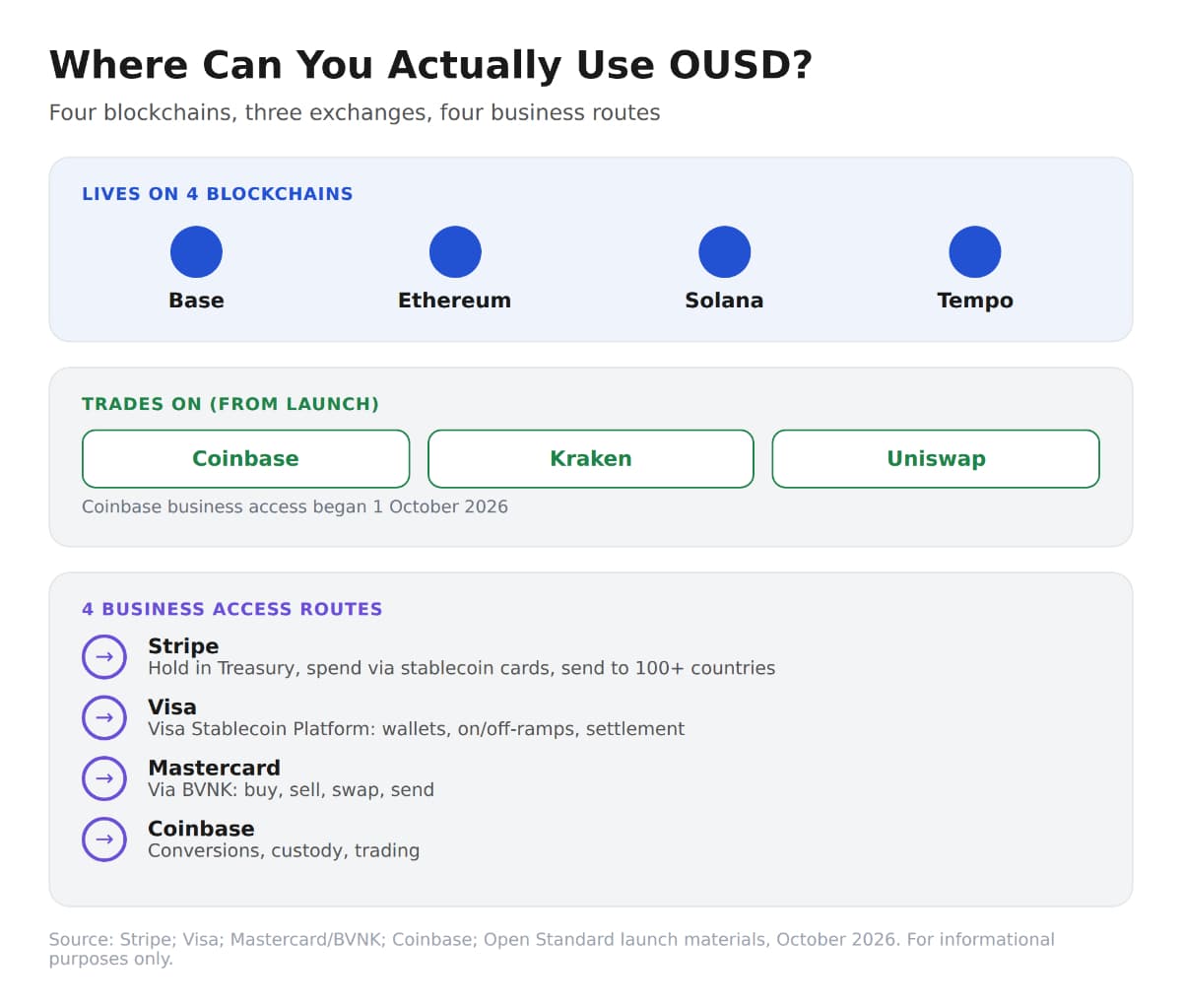
OUSD is natively issued on Base, Ethereum, Solana, and Tempo. At launch, it can be traded on Coinbase, Kraken and Uniswap. Coinbase's business-facing access switched on on 1 October 2026, the day after launch.
There are four primary ways for businesses to interact with the OUSD ecosystem.
1. Stripe: Businesses can hold OUSD in Treasury accounts, spend it with stablecoin cards, and send it to wallets in more than 100 countries.
2. Visa's Stablecoin Platform: Wallets, on-ramps and off-ramps, and settlement are supported.
3. Mastercard's BVNK infrastructure: Buying, selling, swapping, and sending OUSD is supported.
4. Coinbase: OUSD can be converted, held in custody, or traded directly.
Stripe has also made OUSD its default stablecoin configuration on Tempo. Customers can still change the stablecoin and the blockchain if they prefer.
Zach Abrams is the CEO of Open Standard. He held product roles at Square, Coinbase and Brex before co-founding Bridge, which was later acquired by Stripe. Abrams led both Bridge and Open Standard for a while, before moving to focus on Open Standard full-time.
This means the person in charge of Open Standard built the company that now legally issues OUSD. While the two are legally separate, it is good to know this when assessing the true independence of OUSD's governance.
There are a few open questions to consider. These are not reasons to panic, just things that aren't fully settled yet.
Reserve attestations are a plan, not yet a published track record.
There is no publicly available list to support the 200-plus partner network figure.
Current governance leans towards the founding partners, and then the partners that drive the most activity. This is very different from a fully decentralised coin, so it is more accurate to think of OUSD as partner-led infrastructure.
The $1 billion-plus in committed liquidity is a launch pledge. It is not the same as circulating OUSD.
Availability (which exchanges, which countries, which businesses qualify) will likely vary and keep changing over time.
Probably the strongest element of OUSD is its partnerships. These include major global payment networks, a global crypto exchange, a commerce platform, and serious reserve custodians, all around one shared dollar token.
Keep in mind that Open Standard built it. The five founding partners funded it. Bridge Building Inc. issues it. And BlackRock, Lead Bank, and BNY hold the reserves.
For businesses, the pitch is simple: plug into payments, treasury, and cross-border transfers through infrastructure they likely already use. For the stablecoin market, this is a strong sign that major payment and tech companies increasingly see a shared dollar token as core financial infrastructure, not just a crypto side project.
Sources: Open Standard; Stripe; Bridge; Yahoo Finance; Crypto Briefing; PYMNTS; Bitcoin.com News; The Block; Decrypt, October 2026.
India Crypto Research operates independently. The information presented herein is intended solely for educational and informational purposes and should not be construed as financial advice. Before making any financial decisions, it's essential to undertake your own thorough research and analysis. If you're uncertain about any financial matters, we strongly recommend seeking guidance from an impartial financial advisor.