What is IFSCA?
What is the importance of IFSCA?
Powers and jurisdiction of IFSCA
The crypto dilemma
Where tokenisation comes in
Web3 and the fintech sandbox
What this means for you
What's important

IFSCA is the statutory regulator for India's International Financial Services Centres, including GIFT City, and commenced work on 27 April 2020.
With respect to crypto, IFSCA said in December 2024 that it had no plans to regulate crypto exchanges, cryptocurrencies or related virtual assets in the IFSC.
Tokenisation of real-world assets is at the consultation stage, on what we could verify.
 Part of a series
Most of us have a basic understanding of the RBI and SEBI, but fewer know the third regulator behind India's plan to establish the country as a global finance hub, or what that regulator has said (if anything) about digital assets.
Imagine a glass-fronted part of Gujarat where banks, insurers and fund managers serve global clients under rules designed for international finance. This is GIFT City, and the authority that regulates financial activities within its IFSC is IFSCA. If you follow crypto in India, you may have come across IFSCA in stories about tokenisation. This article explains what IFSCA does and what it has, and has not, said about crypto and Web3.
IFSCA stands for the International Financial Services Centres Authority. It was set up under the IFSCA Act, 2019 and started operations on 27 April 2020. Its headquarters are in GIFT City, Gandhinagar. On its website, IFSCA describes itself as the unified authority responsible for the development and regulation of financial products, services and institutions in India's International Financial Services Centres (IFSCs). Before IFSCA was established, the RBI, SEBI, PFRDA and IRDAI regulated different parts of financial activity in the IFSCs. According to IFSCA's website, K. Rajaraman is its Chairperson. As per media reports, his term was extended until October 2028; however, we have not been able to locate the official notification.
Think of IFSCA as a single window. The entire concept revolves around ease of doing business: a global bank or fund setting up in GIFT City can deal with one authority for licences, rules, and supervision, instead of approaching several. IFSCA plays two parts: it regulates financial activities, and it also promotes the development of financial products and services and attracts institutions to the IFSC. It has jurisdiction over the IFSC, not the entire country. Your bank accounts, demat accounts, and mutual funds in India continue to be regulated by their usual regulators, and other Indian laws may still apply to certain activities within the IFSC.
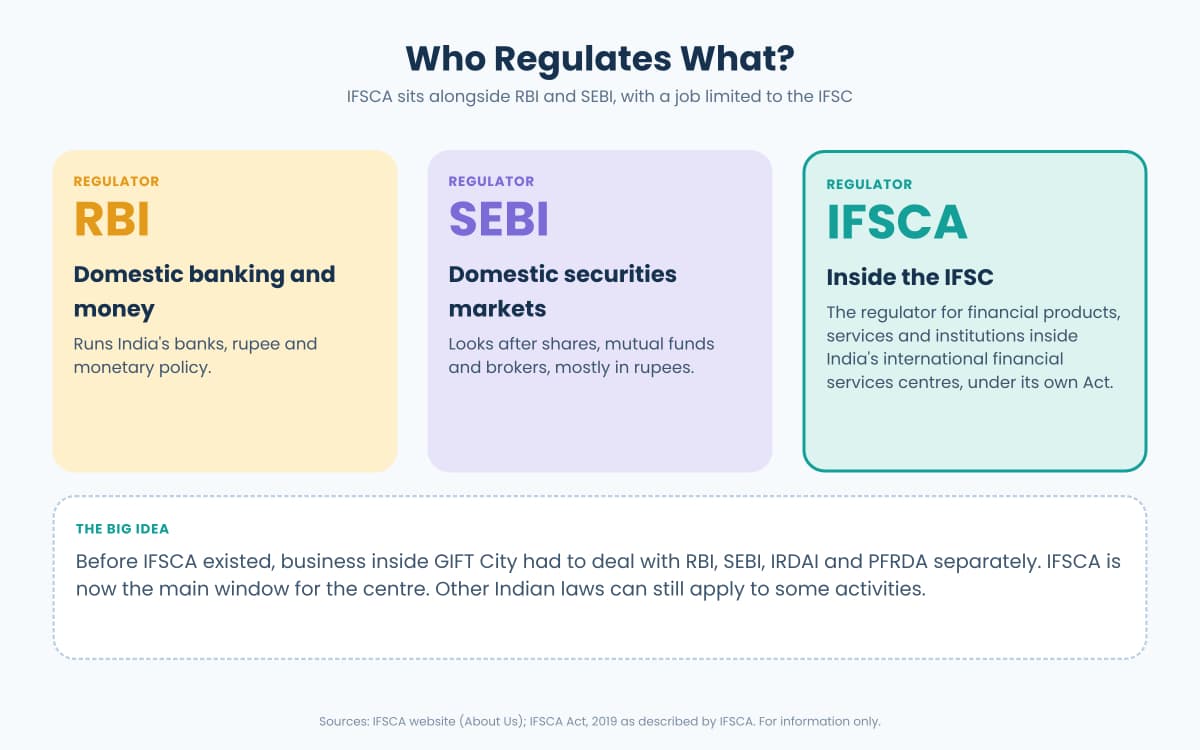
Who regulates what: IFSCA sits alongside RBI and SEBI, with a job limited to the IFSC.
IFSCA's areas of oversight include banking units, capital markets, insurance, fund management, fintech and bullion. As of June 2026, the authority's website reported 1,260 registrations and authorisations, more than USD 120 billion in banking assets, and 127 TechFin and ancillary service providers.
GIFT City may sound like a place where crypto could find a welcoming home, but IFSCA's official statements paint a different picture. In a press release on 18 December 2024, IFSCA responded to media reports about a possible crypto framework and said it had no plans to regulate crypto exchanges, cryptocurrencies or related virtual assets in the IFSC.
This position is also reflected in IFSCA's consultation paper on tokenisation, released in February 2025. The paper excludes cryptocurrencies and crypto-assets and states that IFSCA does not intend to regulate them, permit their trading or otherwise endorse them.
Global Access Providers, firms that help clients access overseas markets from the IFSC, are subject to more specific restrictions under IFSCA's circular dated 12 August 2025. The guidance note to Clause 20 states that providers may not offer access to crypto-assets or to financial instruments whose underlying asset is crypto. Clause 22 separately restricts access to certain derivatives available on IFSC exchanges, including index and single-stock derivatives. For Indian residents, Clause 21 limits access to what is permitted under the Foreign Exchange Management Act and the Liberalised Remittance Scheme. These provisions restrict specified activities; they do not constitute a blanket ban on all crypto-related activities in India. A circular dated 12 September 2025 amended the clauses relating to bank accounts.
So, just because an offering is "approved in GIFT City", this does not automatically mean crypto trading is permitted or endorsed by IFSCA. Ask to see the specific authorisation and check exactly what it allows.
Tokenisation is the process of representing ownership of a real-world asset, such as a bond, fund unit, commodity or property, as a digital token. IFSCA published a consultation paper on the topic on 26 February 2025. It considers physical and financial assets, excludes assets that exist only on a ledger, and asks whether issuing, safekeeping and trading digital tokens should be regulated activities. The original deadline for comments was 20 March 2025; an IFSCA notice dated 19 March 2025 extended it to 30 April 2025.
A consultation paper proposes an approach; it is not a binding rule. At the time of our review, final tokenisation regulations did not appear on IFSCA's website, and no such circular appeared among the recent items on its homepage. However, the circular and consultation listings did not load fully when we checked, so readers should confirm the latest position on the live website. Separately, reports say that a private member's bill on asset tokenisation was introduced in the Rajya Sabha in March 2026. It is not a government bill, and its passage is considered unlikely.
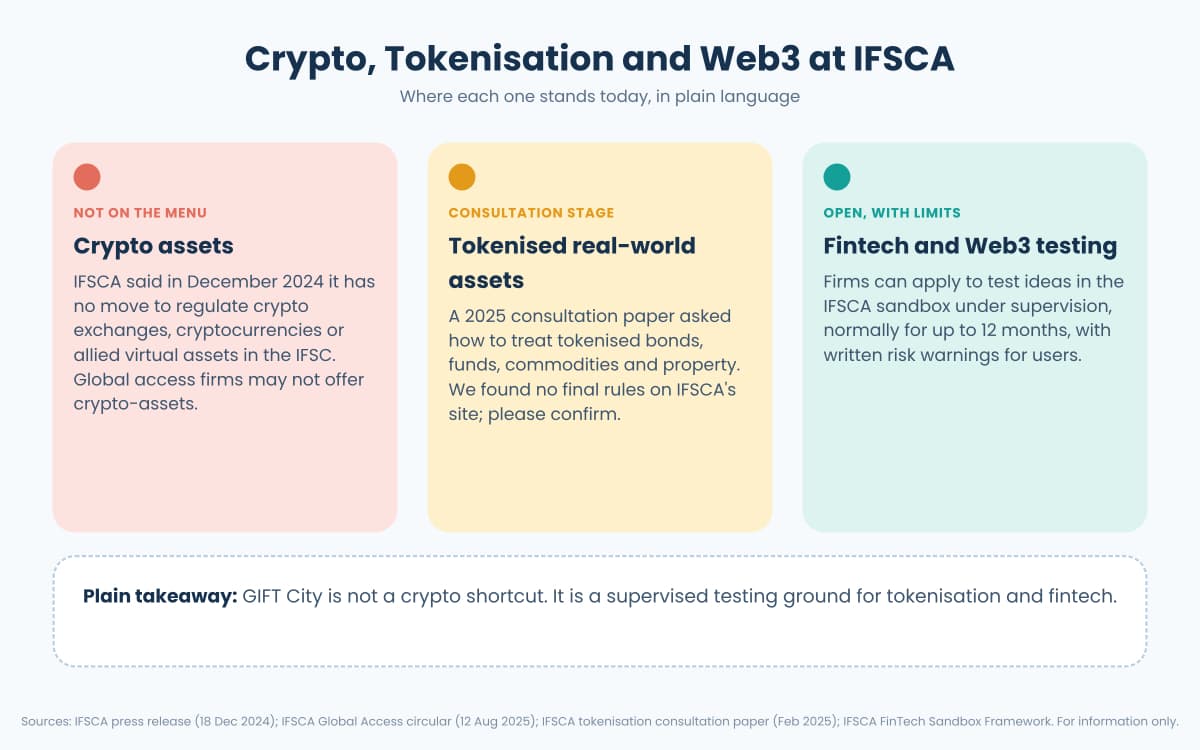
Crypto, tokenisation and Web3 at IFSCA: where each one stands today.
A practical route for testing new technology is the IFSCA FinTech Sandbox Framework 2026, listed on IFSCA's FinTech page. Dated 16 March 2026, it replaces the earlier sandbox and fintech-entity rules. Approved companies may receive a Limited Use Authorisation to test their ideas within set limits. Testing generally lasts up to 12 months, with a possible six-month extension. Before users are onboarded, they must receive written risk disclosures and give their consent, and participating firms must submit monthly reports. Distributed ledger technology and Web 3.0 are listed among the framework's TechFin services. We found these details in legal summaries, as we could not access the full framework text directly.
According to a sponsored press release, the Dubai-based maritime tokenisation platform Shipfinex has been granted sandbox authorisation. We were unable to find its authorisation in IFSCA's directory, so we treat this as a company claim until it is independently confirmed. It's worth noting that sandbox authorisation does not mean IFSCA endorses the product, or that the product is safe.
• Crypto trading is not IFSCA's aim. Tax and reporting rules for crypto remain with India's usual authorities.
• Tokenisation is the live policy topic. However, it is at the consultation stage, as far as we could verify.
• Sandbox does not mean safe. A firm in the sandbox is not a fully licensed firm.
• Check before you trust. Ask who the firm is, what it is authorised to do and where that authorisation is published.
IFSCA regulates financial activity within GIFT City, India's global finance hub. Its official position on crypto is clear, its work on tokenisation is still developing, and its sandbox gives innovators a supervised environment to test new ideas. When you hear "GIFT City" and "crypto" mentioned together, take a second look and read the fine print.
Sources: IFSCA, indiajuris, TaxGuru, Ledger Insights, Business Standard, Elets eGov
India Crypto Research operates independently. The information presented herein is intended solely for educational and informational purposes and should not be construed as financial advice. Before making any financial decisions, it's essential to undertake your own thorough research and analysis. If you're uncertain about any financial matters, we strongly recommend seeking guidance from an impartial financial advisor.