America completes its stablecoin rulebook.
Canada drafts its own stablecoin rules.
Asia puts stablecoins to work
Other developments this week
India: no new rules, but the gap is widening
What to look for next

United States: The OCC finalised its stablecoin rules on 21 October. Stablecoin issuers will be checked like banks from 18 January 2027. Meanwhile, Ripple won approval to start a national trust bank.
Canada: Draft rules would ban stablecoin issuers from paying interest for holding coins and require them to give money back within three business days. Comments can be submitted until 23 December.
Asia: HSBC launched a Hong Kong dollar stablecoin for 3.3 million app users. Malaysia and Thailand also joined Singapore's BLOOM payments project.
Europe and Dubai: France said crypto exchanges should share responsibility for DeFi risks. Dubai licensed Bybit for spot crypto trading.
 Part of a series
Stablecoins were the biggest story of the week. America completed its rulebook, and Canada published its draft, and in Asia, a major bank and three central banks started using stablecoins for real payments. Here is what happened between 21 and 27 October, in easy-to-understand language.
On 21 October, the Office of the Comptroller of the Currency (OCC), which supervises national banks in the US, published the final rules for stablecoins under the GENIUS Act, the stablecoin law passed in July 2025.
A stablecoin is a crypto token meant to hold a steady value, usually one US dollar. The rules will come into effect on 18 January 2027.
The core idea is simple. Every coin must be backed one-for-one by safe assets such as US government bonds and bank deposits. Issuers cannot set their own limits on when a customer can ask for their money back, and that request has to be processed within two business days. Each stablecoin issuer must also keep a minimum of $5 million (about ₹47.5 crore) of its own money, plus enough to cover a year of running costs if it has to close.
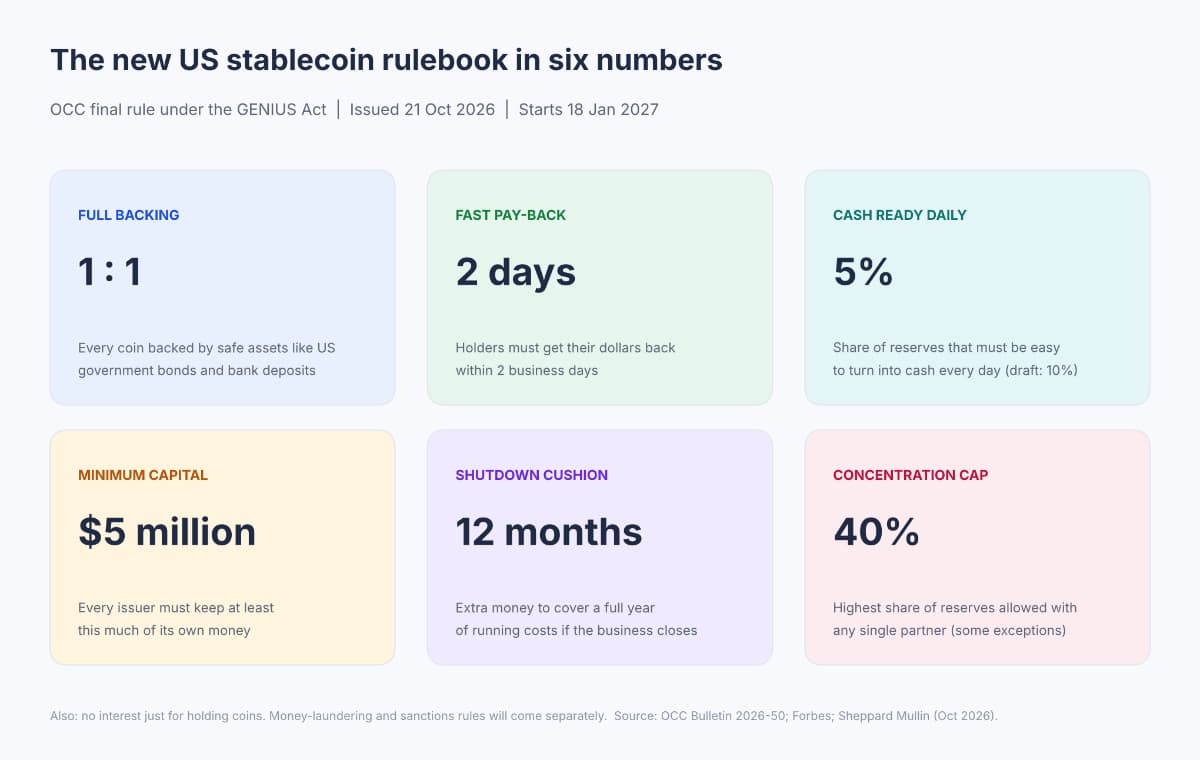
The new US stablecoin rulebook in six numbers. Sources: OCC Bulletin 2026-50, Forbes, Sheppard Mullin (Oct 2026).
Issuers will be inspected at least once a year and file weekly reports. They will also need to publicly disclose what backs their coins on a monthly basis. Issuers will not be able to pay interest just for holding the coins. The OCC eased one part of its March draft, cutting the daily cash buffer from 10% to 5% of reserves. Rules on money laundering and sanctions will come separately from this framework.
The rule has not found universal acceptance. S&P Global says the rule still leaves room for some rewards, which revives banks' fear that deposits will shift to stablecoins. A US community bank group has also filed a lawsuit against the OCC, claiming crypto firms are getting in with less scrutiny than small banks.
On 26 October, Ripple announced final OCC approval for Ripple National Trust Bank. A trust bank looks after assets for others; it does not take ordinary deposits or extend loans. Ripple will use the trust bank to manage the reserves behind its dollar stablecoin, RLUSD, which has more than doubled this year to about $2.6 billion in circulation.
Meanwhile, Canada has also drafted its own rules for stablecoins. On 24 October, the Canadian government began a 60-day public consultation on draft rules under its Stablecoin Act, passed in March 2026. Issuers would need to register with the Bank of Canada, maintain reserves at least equal to the stablecoins in circulation, and keep those reserves with a Canadian bank, credit union or trust company. Holders could cash out within three business days, with fees capped at 1%. Like the US, Canada would not allow issuers to pay interest for holding coins, even through a third party, though payment-linked rewards would be allowed.
Comments are open until 23 December, and the rules are expected to start towards the end of 2027. Analysts say the rules are likely to increase costs for smaller issuers, and the interest ban could make Canadian stablecoins less attractive to savers.
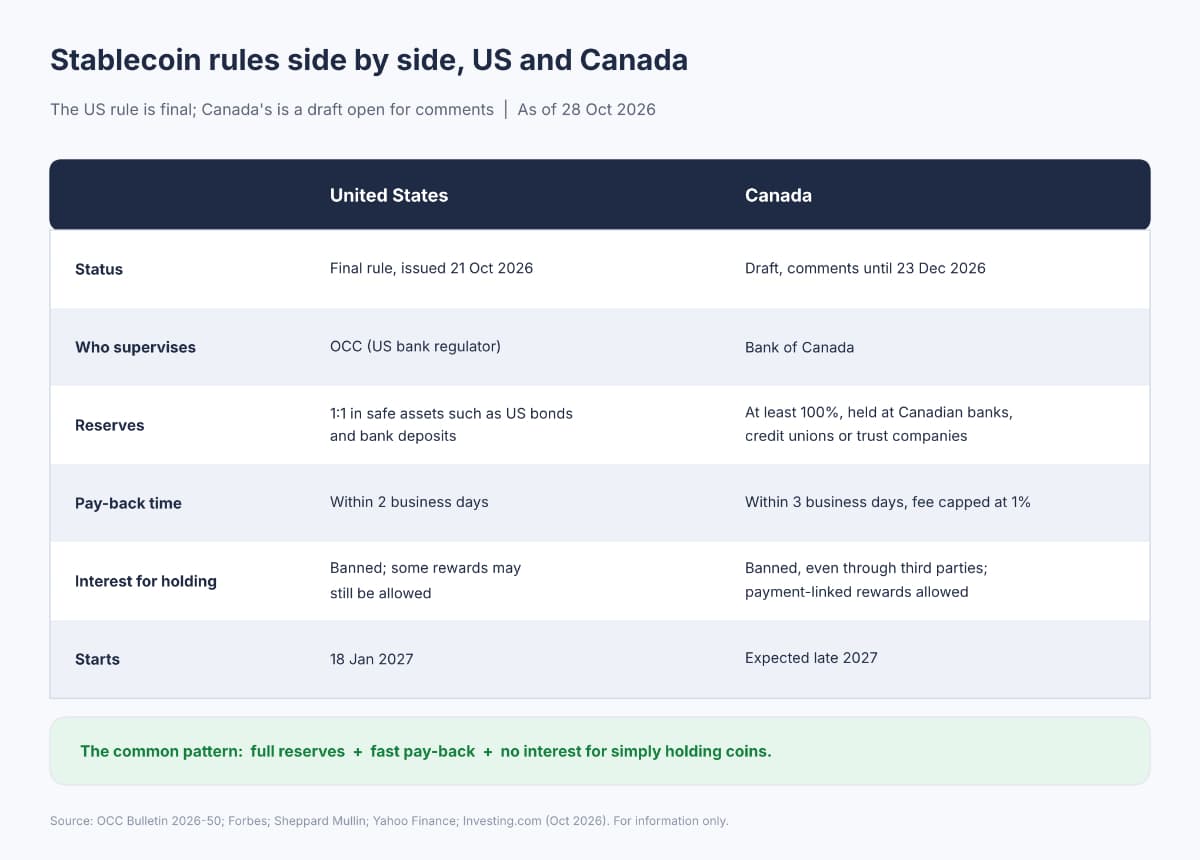
Stablecoin rules side by side, US and Canada, as of 28 October 2026.
While North America writes rules, parts of Asia are already using stablecoins for everyday payments, run by banks and central banks rather than private crypto firms.
On 23 October, HSBC launched RedCoin (RCHKD), a stablecoin pegged to the Hong Kong dollar and issued by HSBC. It is licensed by the Hong Kong Monetary Authority (HKMA), which granted HSBC a stablecoin issuer licence in April. Within HSBC's payment app PayMe, more than 3.3 million users can turn on a wallet and pay at more than 100,000 shops. Later this year, HSBC plans to add RedCoin to its main banking app.
Also on 23 October, the Monetary Authority of Singapore (MAS) announced that Bank Negara Malaysia and the Bank of Thailand had joined its BLOOM project. BLOOM tests how regulated stablecoins and tokenised bank deposits, which are ordinary bank money in digital token form, can move between countries with identity and sanctions checks built in. Partners include Visa, Mastercard, Ripple, Circle, Coinbase and the World Bank Group.
China has taken a different approach. Its Central Cyberspace Affairs Commission set a target to largely complete a national blockchain network by 2030. China's central bank still opposes cryptocurrency but supports blockchain for uses such as cross-border tax payments.
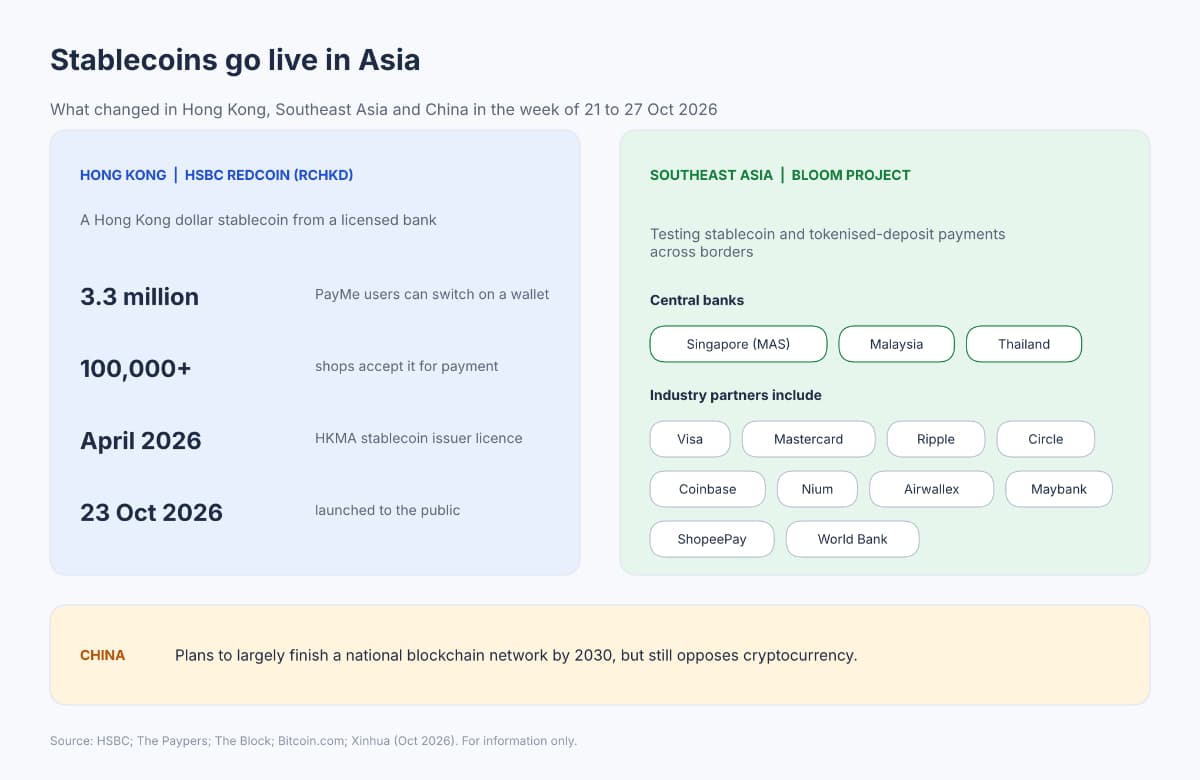
Stablecoins go live in Asia: Hong Kong, Southeast Asia and China, 21–27 October 2026.
Four more examples show how licences, politics and sanctions are shaping crypto regulation.
France: Several French authorities, including the Treasury, the markets regulator AMF, the central bank and the banking supervisor ACPR, have proposed amendments to MiCA, the EU's crypto law, which is under review. If an exchange gives customers access to DeFi apps, which run lending or trading through code instead of a company, France wants the exchange to vet those apps and take responsibility for some losses if things go wrong. It also wants the biggest exchanges supervised by ESMA, the EU's markets watchdog.
Dubai: On 22 October, Dubai's Virtual Assets Regulatory Authority (VARA) granted Bybit's Dubai company a licence for spot trading, meaning buying and selling crypto directly. Other activities, such as futures trading, would require separate approval.
US politics: Bitcoin Magazine, citing a Reuters review, reports that crypto groups have spent about $176 million (about ₹1,672 crore) across more than 100 US midterm races. Most of the spending came from the Fairshake super PAC and its affiliates. The Clarity Act, a bill on how crypto markets should be structured, remains stuck in the US Senate.
Israel: On 25 October, Prime Minister Benjamin Netanyahu said Israel should prepare to use crypto to get around possible banking sanctions. The Bank of Israel rejected the idea, and more than 100 former officials and experts also warned against it.
We didn't find any new official crypto rules from Indian authorities between 21 and 27 October. India still taxes crypto gains at 30% and deducts 1% tax at source on transfers, but no law currently licenses stablecoin issuers. On 3 October, RBI Governor Sanjay Malhotra said that India remains cautious on crypto while backing tokenisation. In July, Parliament's Standing Committee on Finance suggested that an interim self-regulatory body be set up for the crypto sector until a full law is in place.
With the US, Canada, Hong Kong and Southeast Asia all moving on stablecoins, the main question is: will India permit regulated stablecoins, or rely solely on its own digital rupee?
United States: The OCC rules take effect on 18 January 2027, along with the separate money-laundering and sanctions rules.
Canada: Industry feedback on the draft rules before the 23 December deadline.
Asia: How quickly RedCoin is adopted, and the first BLOOM payment tests involving Malaysia and Thailand.
Europe: Whether France's DeFi ideas make it into the European Commission's MiCA review, due by 30 June 2027.
India: Whether the government responds to the Standing Committee's call for crypto self-regulation.
Sources: OCC, Forbes, Sheppard Mullin, S&P Global, The Paypers, PYMNTS, Yahoo Finance, Investing.com, HSBC, American Banker, The Block, Bitcoin.com News, Bitkub, Xinhua, Cointelegraph, Bybit, NewsBTC, Bitcoin Magazine, Al Jazeera, crypto.News, Swarajya
India Crypto Research operates independently. The information presented herein is intended solely for educational and informational purposes and should not be construed as financial advice. Before making any financial decisions, it's essential to undertake your own thorough research and analysis. If you're uncertain about any financial matters, we strongly recommend seeking guidance from an impartial financial advisor.