
1. What Is the Federal Reserve?
2. Why the Fed Raised Rates
3. The Last Rate Hike
4. Hawkish or Dovish?
5. Effects on Crypto, Gold, Stocks and Oil
6. More Rate Hikes Ahead
7. Where Do Markets Go From Here?

On September 16, 2026, the Federal Reserve raised its target federal funds rate by 0.25 percentage points, the first change to the target range in over three years. While this change may appear small, it has large, broad impacts.
Understanding the motivation behind this change requires some knowledge of the Federal Reserve. The Federal Reserve is the central bank of the United States, and in this role sets the base rates for the U.S. economy. The rates set by the Fed impact many of the rates charged by financial institutions, such as the interest charged on a mortgage.
The Fed has an explicit mandate from the U.S. government to manage inflation and employment. In managing these two components of the economy, conflict is common. In these situations, the Fed prioritises one of the two mandates.
The recent rise in the price of a barrel of oil, driven by the ongoing conflict between the U.S. and Iran, pushed the price of a gallon of gasoline higher in the U.S., with Brent settling around $108.75 a barrel. The rise in gasoline prices drove inflation higher and put further pressure on the Fed to raise interest rates. Consumer prices rose 3.4% year-on-year in August, matching July, and staying well above the Fed's comfort zone.
Generally speaking, central banks will often look past short-term changes in oil prices. This time, the Fed was able to do the same, because the U.S. labour market is strong and continuing to improve, giving it room to act without risking a slowdown. The Fed has stated that it expects inflation to return to its 2% goal "over time," but the inflation target is only part of the story. The Fed has communicated to the market that some near-term pain is expected on the way to that 2% goal. This happened despite President Trump publicly and repeatedly pushing for lower rates, not higher ones.
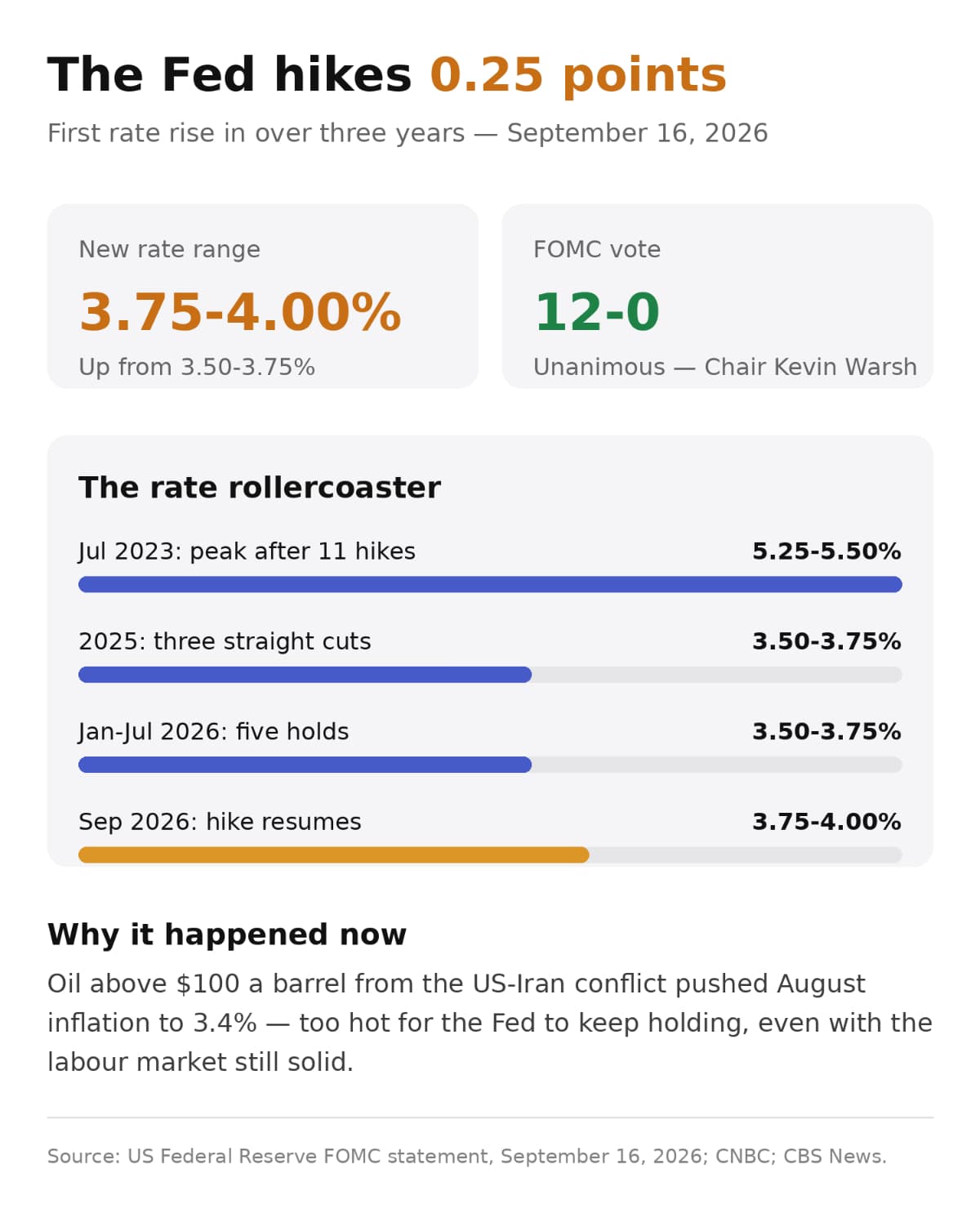
The federal funds rate was last raised in July 2023, the culmination of eleven hikes that took rates from near zero to 5.25% to 5.50%, the highest level in 22 years, in response to inflation that had spiked above 9% in 2022.
Between 2023 and 2026, the Fed eased off. It held rates steady, then cut three times in a row through the back end of 2025, then held again for five consecutive meetings across the first half of 2026. The target range was increased again in September 2026, effectively undoing one of those earlier cuts. A genuine reversal in direction, not just a pause.
A hawkish move by the FOMC was widely expected by markets, with over a 90% probability priced in ahead of the decision. However, the tone of the statement and press conference left markets with the impression that the Committee was even more determined to bring down inflation than previously anticipated.
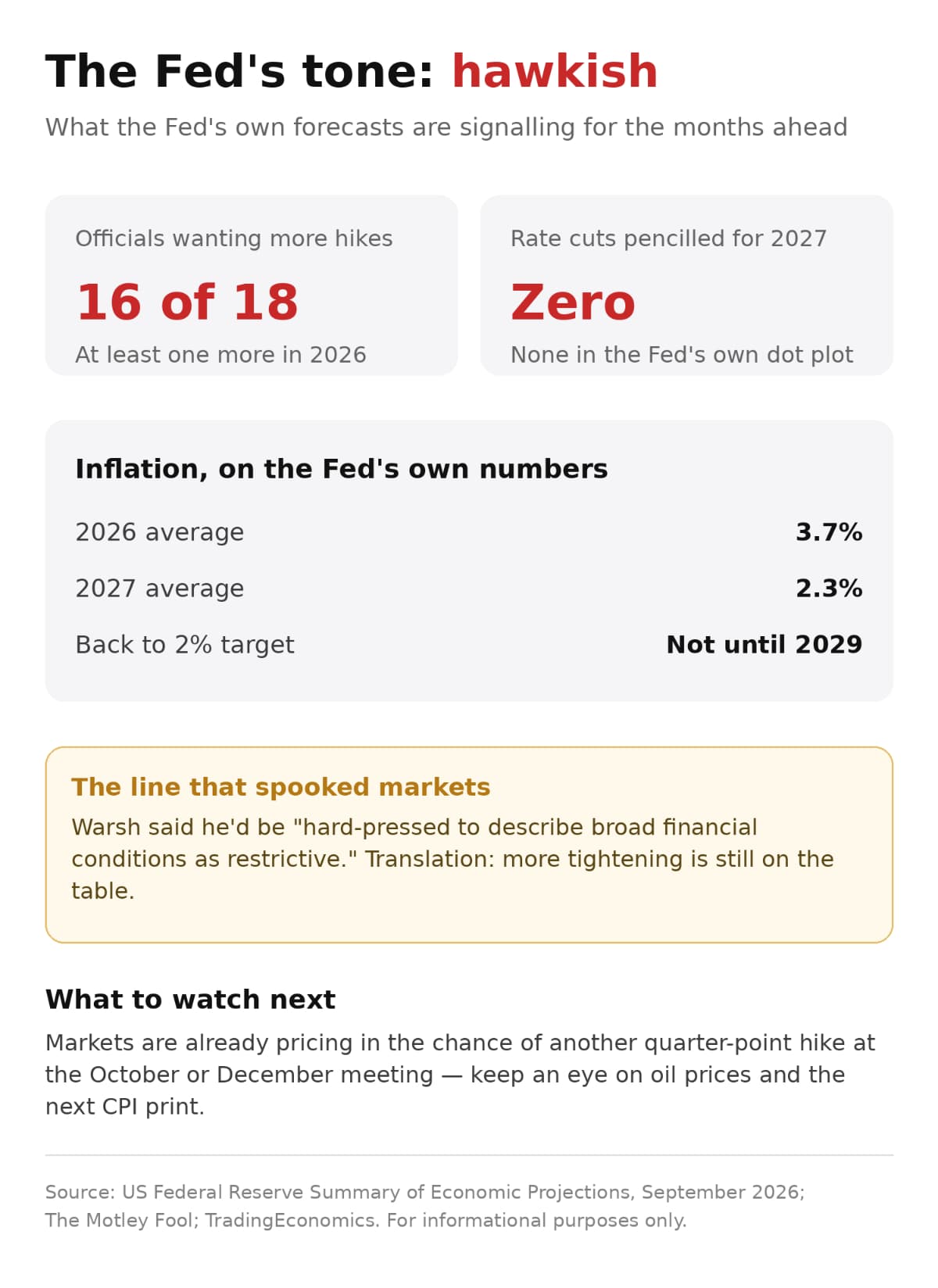
FOMC Chair Kevin Warsh stated he'd be "hard-pressed to describe broad financial conditions as restrictive." Translation, more rate hikes are likely coming. The Fed's own long-term projections point the same way. 16 of the 18 policymakers who submitted forecasts pencilled in at least one more hike before the year is out, and no forecasts currently indicate a cut by 2027. Stocks were higher earlier in the day but turned more negative once Warsh began speaking at the press conference.
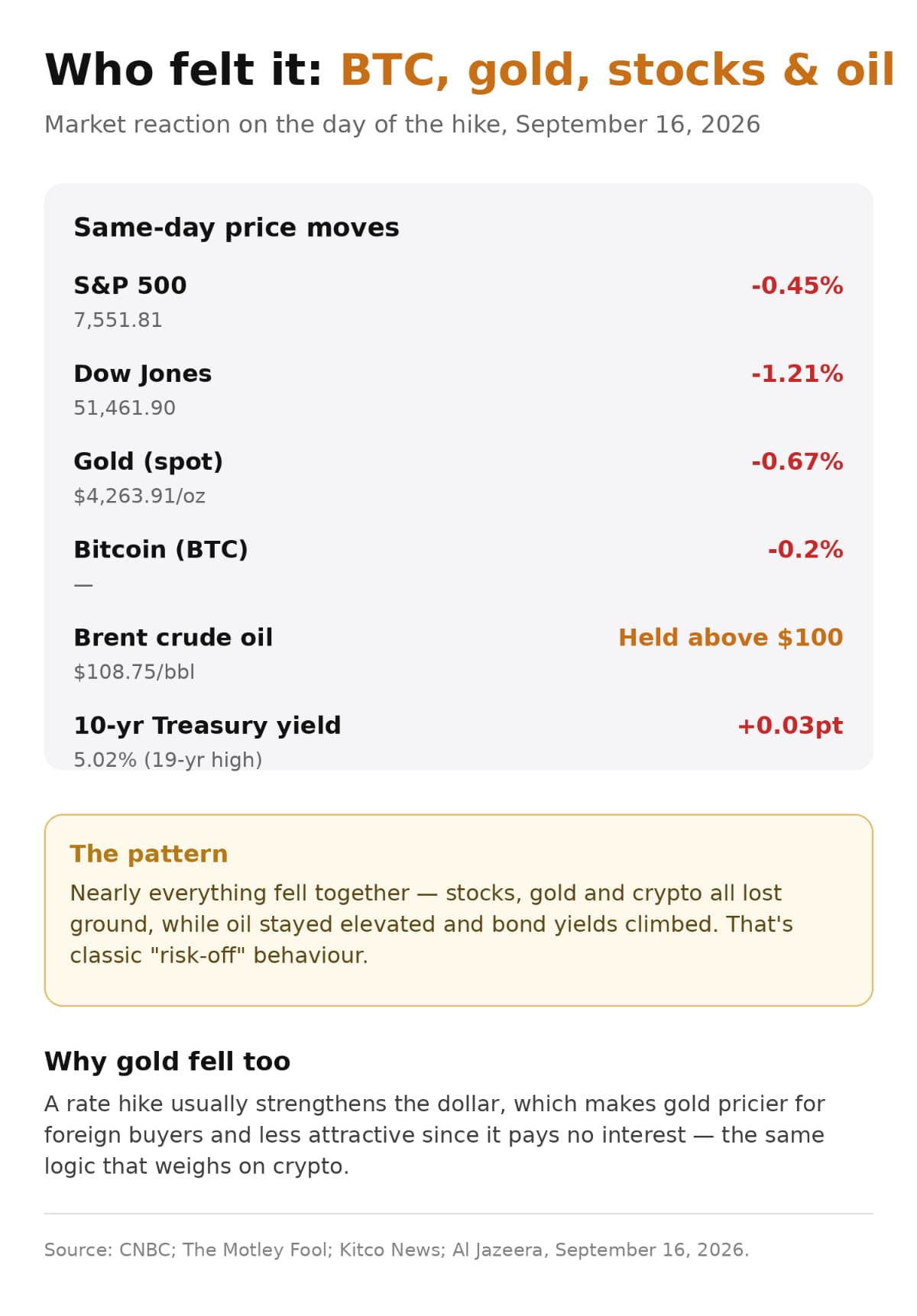
Traditional markets all trended in the same direction that day, down, in classic risk-off conditions. The Dow fell 631 points (1.21%) to close at 51,461.90, its worst day in weeks, with bank stocks hit especially hard. The S&P 500 slipped 0.45% and the Nasdaq basically flatlined, down just 0.01%.
Gold gained over 1% earlier in the session, touching $4,365, before reversing to end the day down 0.67% at $4,263.91 once Warsh's hawkish tone sank in. Oil stayed elevated throughout the day. The 10-year Treasury yield ended the day at 5.02%, its highest level since 2007.
A read of the Fed's own dot plot, a chart of where each official thinks rates should go, points to more hikes this year. 16 of the 18 officials expect at least one more hike before year end, and four of them are projecting at least two more. The smart money is on at least a 0.25% hike at either the October or December meeting.
The Fed has also revised its inflation projections higher. It now expects inflation to average 3.7% in 2026 and 2.3% in 2027, and doesn't see it settling back at the 2% target until 2029, a longer runway than the Fed was signalling just a few months ago. With Iran tensions keeping crude prices elevated, the next couple of CPI reports and any developments in the region will likely determine the Fed's next move.
The past and projected rate hikes don't point to a bear market, but they will slow and disrupt the market. History shows that rate hikes tend to get baked in over time. Research from Goldman Sachs shows the S&P 500 has, on average, dipped around 2% in the months right after a rate hike, but gone on to gain roughly 9% over the following year.
This is really a test for gold and crypto investors. Short-term, the pressure is bearish. Long-term, depending on how current geopolitical risks and inflation play out, the outcome could turn positive. Ultimately, this FOMC meeting matters less than those other variables.
Data as of September 17, 2026. Sources: US Federal Reserve FOMC statement and Summary of Economic Projections, September 16, 2026; CNBC; CBS News; Al Jazeera; The Motley Fool; Kitco News; TradingEconomics.
India Crypto Research operates independently. The information presented herein is intended solely for educational and informational purposes and should not be construed as financial advice. Before making any financial decisions, it's essential to undertake your own thorough research and analysis. If you're uncertain about any financial matters, we strongly recommend seeking guidance from an impartial financial advisor.


