1. How It Started (2021–2022)
2. Current Status (October 2026)
3. Bitcoin Mining Explained
4. Hydropower Bitcoin Mining in Ethiopia
5. Role of the Government
6. Companies Involved
7. The Grid Problem
8. Government Bitcoin Holdings in Global Context
9. Can Foreigners Invest in the Ethiopian Bitcoin Ecosystem?
10. Taxation & Cost Summary (2026)
FAQs

Ethiopia's model is the reverse of El Salvador's. Bitcoin is not legal tender and the state does not hold Bitcoin. Ethiopia earns U.S. dollars by selling hydropower to foreign miners.
Mining was legalised in August 2022 as licensed "data mining", only weeks after the central bank banned crypto trading.
Miners became the state utility's single largest customer group, using almost a third of national electricity.

 Part of a series
Key Facts
| Official Name | Federal Democratic Republic of Ethiopia |
| Capital | Addis Ababa |
| Borders | Eritrea, Djibouti, Somalia, Kenya, South Sudan, Sudan (landlocked) |
| Population | Roughly 130 million; about half lack reliable electricity |
| Currency | Ethiopian Birr (ETB) |
| Bitcoin Legal Status | Mining is legal as licensed "data mining" (since 2022); crypto trading/payments are banned by the National Bank of Ethiopia |
TL;DR
Ethiopia hasn't adopted Bitcoin as currency. Rather, it profits by selling excess hydropower (mostly from GERD) to foreign miners who pay in dollars. The miners migrated after China's 2021 ban and pushed Ethiopia to about 2.4% of the global hashrate. From 2025, the state stopped issuing new permits, raised tariffs and, in September 2026, cut miners to 23% of contracted power during a drought. The state is now planning a state-backed mining venture of its own.
Ethiopia's Bitcoin story begins in China. In 2021, the Chinese government banned cryptocurrency mining, pushing hundreds of mining operators and millions of machines to relocate to other places with cheap and reliable sources of electricity.
Ethiopia's regulations on cryptocurrency seemed contradictory. In 2022, the National Bank of Ethiopia (NBE) declared the buying, selling, and using of cryptocurrencies illegal, and stated that no licence had been issued for cryptocurrency exchanges. Yet in August 2022, the Information Network Security Administration (INSA), Ethiopia's cybersecurity agency, legalised "high-performance computing" and "data mining", and Bitcoin mining fell under that definition.
The last part of the puzzle was power. The Grand Ethiopian Renaissance Dam (GERD) and other dams produced more electricity than Ethiopia's weak domestic power network could deliver. The state utility, Ethiopian Electric Power (EEP), entered into long-term contracts with miners and sold them electricity at about 3.14 U.S. cents per kWh, payable in dollars. This was quite attractive for a country short of foreign currency like Ethiopia.
Ethiopia accounts for about 2.4% of the global hashrate, about 23 EH/s. EEP has power purchase agreements with 39 mining companies, and about 31 are in operation. In the 2025/26 financial year, miners paid 50.37 billion birr to the utility, more than any other customer group.
While the industry has seen rapid growth, it has now hit its limits. In 2025, EEP stopped approving new mining power purchase agreements because the grid was at full capacity, leaving about 20 companies on a waiting list. From 1 December 2025, the cheap flat rate was replaced by a time-of-use and availability tariff, which started with a 32% increase and is scheduled to lift the base price to 6.5 cents per kWh by year three. On 15 September 2026, an El Niño-linked drought cut reservoir inflows by at least 20%, and EEP lowered miners' power allocations to just 23% of their contracts, even though the contracts promised at least 98%. The utility will reassess the allocation in October 2026.
At the same time, the government wants a larger share of the profits. In January 2026, Prime Minister Abiy Ahmed announced that Ethiopian Investment Holdings (EIH) is seeking international partners for a state-backed mining venture. EIH is expected to take 20–30% stakes in new large-scale mining facilities.
In simple terms, Bitcoin mining is a process in which specialised ASIC computers compete to validate the next block of transactions on the Bitcoin blockchain. The winner is rewarded with newly issued bitcoin plus the transaction fees.
A mine needs electricity, hardware, cooling, an internet connection and a connection to a mining pool. Of these costs, the major cost is electricity, which can be 60–80% of total costs because the machines run 24 hours a day. This explains the appeal of Ethiopia. Older mining machines, such as the Antminer S19, lose money in high electricity cost markets. However, with cheap hydroelectricity, like in Ethiopia, they can become profitable again.
Ethiopia's electricity grid is about 95% hydroelectric. The Grand Ethiopian Renaissance Dam (GERD), inaugurated on 9 September 2025, has a capacity of about 5,150 MW and supplies about half of the country's generation. Miners are not extracting bitcoin "from" the dam. The dam generates hydroelectricity, which EEP sells under contract to Bitcoin mining firms. The firms mine and own the bitcoin, while the Ethiopian state is paid in U.S. dollars for the electricity.
How the Mining Process Works, Step by Step
| Step | What happens |
|---|---|
| 1. Energy Generation | GERD and other dams turn river flow into electricity. |
| 2. Power Purchase Agreement | EEP allocates megawatts to a miner under a USD-priced contract. |
| 3. Pool Mining | Machines join a mining pool and earn a share of block rewards. |
| 4. Bitcoin Custody | Mined BTC goes to the operator's own wallets, usually offshore. |
| 5. Dollar Settlement | The miner pays EEP in USD, adding to national foreign-exchange reserves. |
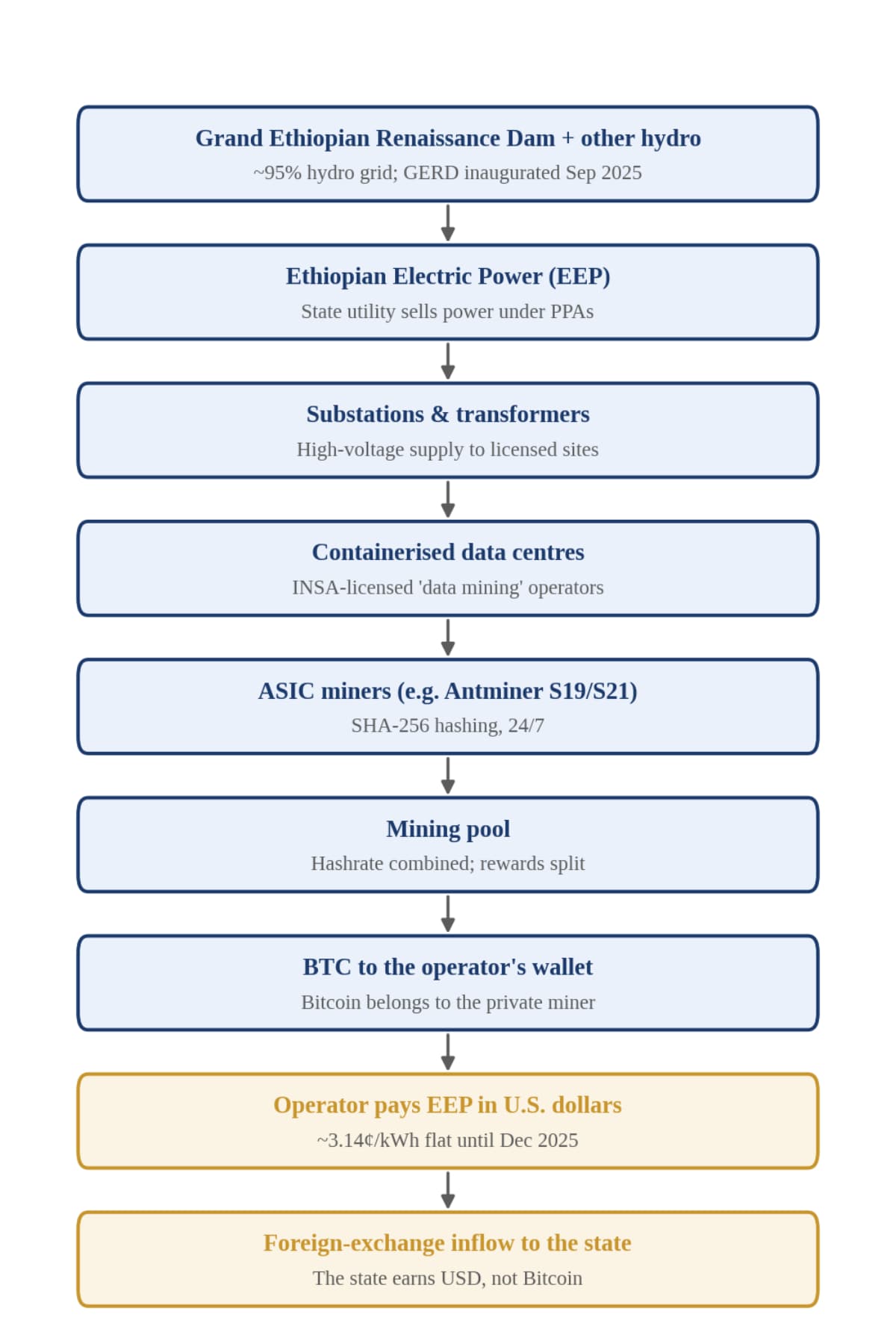
Figure 1: From hydropower to a private miner's wallet, and how dollars flow back to the Ethiopian state.
A number of government institutions have a say over the sector. Ethiopian Electric Power (EEP) is the most powerful body. It signs power purchase agreements, sets electricity rates and decides who gets rationed. The head of EEP, Ashebir Balcha, described mining as a "temporary bridge." The Information Network Security Administration (INSA) licenses the operators. The National Bank of Ethiopia bans crypto trading but benefits from mining-related dollar inflows. The sovereign wealth fund, EIH, first entered the sector in February 2024 through a $250 million data-mining memorandum with Hong Kong-based West Data Group. Since 2026, it has led the plan to make the state a direct owner of mining capacity.
Most of the companies in the sector are foreign-owned. In October 2024, Nasdaq-listed BitFuFu, backed by Bitmain, acquired a majority stake in an 80 MW facility, its first owned mining site. BIT Mining, also of China origin, acquired a 51 MW site with 17,869 rigs for $14.3 million in December 2024. In 2025, Bitmain's spin-off, Bitdeer, entered the market. Abu Dhabi's Phoenix Group grew to about 132 MW and energised a further 30 MW in Addis Ababa in November 2025. Bitcluster of Russia operates a hosting site of about 120 MW near Addis Ababa. Local participation is small. Hashlabs Mining provides hosting and advisory services, while QRB Labs is the only Ethiopian-founded mining company.
Fairness is the main issue here. Crypto data centres were forecast to use about 8 TWh of Ethiopia's power in 2025, roughly 30% of the nation's total electricity demand, while about half of the population still lacks reliable power. Analysts also link GERD-powered mining to tensions along the Nile with Egypt and Sudan. The September 2026 cut exposed the model's core weakness. The "hydro surplus" depends on the amount of rain Ethiopia receives, and when water runs short, miners are the easiest load for the state to switch off.
Unlike Bhutan or El Salvador, Ethiopia has no verified sovereign Bitcoin stack. According to Arkham's October 2026 data, government holders include the US (307K BTC), UK (61K), El Salvador (7.3K), the UAE via Citadel Mining (7.1K), Russia (1K), and Bhutan (518). No Ethiopian government wallet has been identified on-chain. That's because Ethiopia sells its power for dollars rather than mining for itself. So Ethiopia's Bitcoin position is measured in hashrate (about 2.4% of the global total) and dollar revenue, not in reserves. That may change if EIH's venture keeps the Bitcoin it mines.
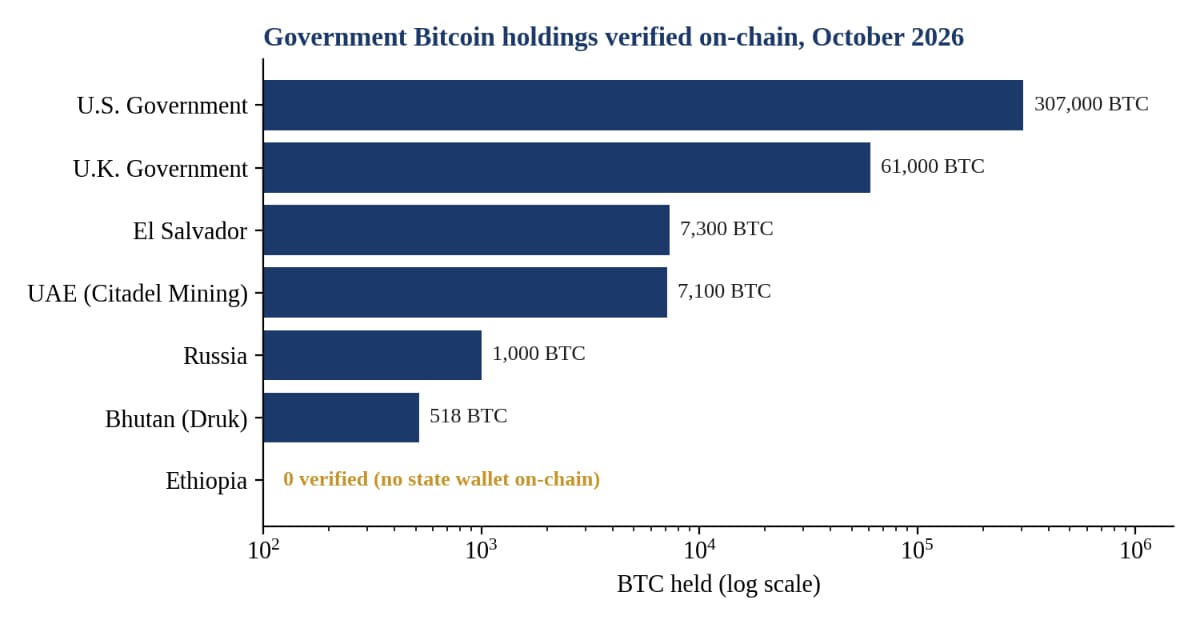
Figure 2: Governments by verified on-chain Bitcoin holdings. Source: Arkham Intelligence, October 2026.
EEP's income from miners increased from about $55 million over 10 months of FY2023/24 to about $220 million for FY2024/25, and EEP projected $312.5 million for FY2025/26. The 2026 drought cut puts the next year's figures in doubt.
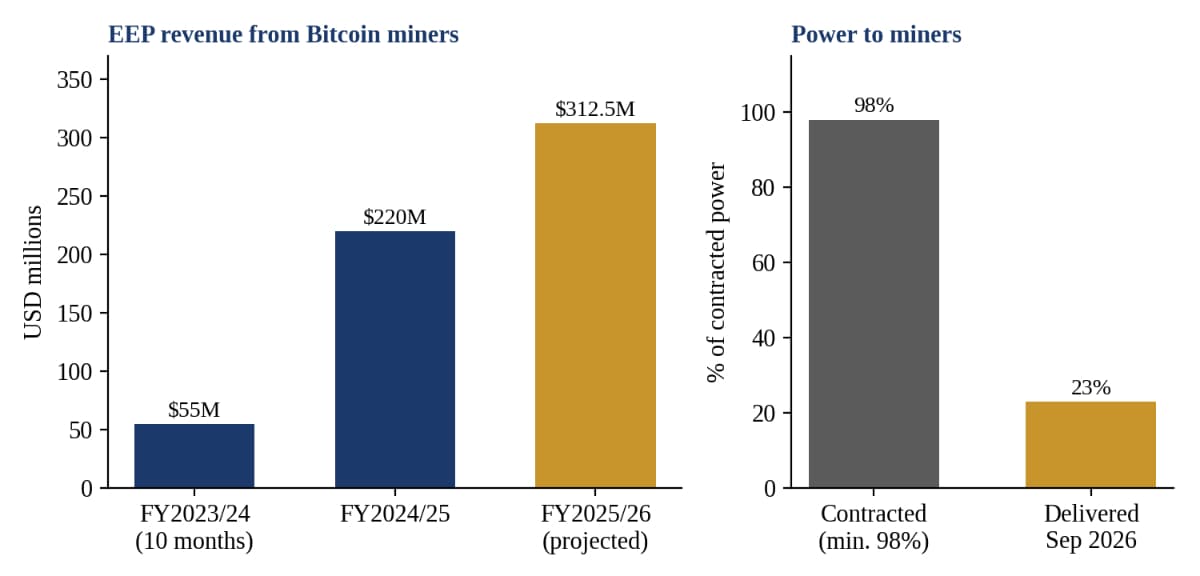
Figure 3: EEP revenue from miners (FY2025/26 is EEP's projection; reported actual was 50.37bn birr) and the September 2026 power cut.
Foreigners are unable to purchase Bitcoin via Ethiopian platforms, as cryptocurrency trading is prohibited locally. Any Bitcoin purchased would be bought abroad. Opening a new mine is effectively closed in 2026, since power permits have been frozen and the import of mining equipment and power transformers has been restricted. The only practical route is indirect exposure. This means investing in listed mining companies with operations in Ethiopia, such as BitFuFu, BIT Mining, Bitdeer or Phoenix Group, or taking a partnership role in Ethiopian Investment Holdings' (EIH's) state venture. Investors should check curtailment clauses and dollar repatriation.
Electricity, paid in U.S. dollars, is the major cost for mining companies and is rising with the new tariffs. Other costs for mining companies are corporate income tax at 30% and VAT at 15%.
| Item | Detail |
|---|---|
| Corporate income tax | 30% standard rate. |
| VAT | 15% standard rate. |
| Electricity (before Dec 2025) | Flat ~3.14¢/kWh, paid in USD. |
| Electricity (from Dec 2025) | Time-of-use + availability tariff; +32% at launch, base rising to 6.5¢ by year three, peak 7.2¢ by July 2028. |
| Supply risk | Cut to 23% of contract (Sep 2026); bills fall when supply falls short. |
| Crypto trading | Prohibited; no licensed exchange. |
Sources: Arkham Intelligence – Top BTC Holders (October 2026); Bloomberg, TFTC, BitKE – EEP cuts miners to 23% of contracted power (September 2026); BitKE, CoinPedia – EIH state-backed mining plan (January–February 2026); company releases from BitFuFu, BIT Mining and Phoenix Group; Forbes on EIH–West Data.
India Crypto Research operates independently. The information presented herein is intended solely for educational and informational purposes and should not be construed as financial advice. Before making any financial decisions, it's essential to undertake your own thorough research and analysis. If you're uncertain about any financial matters, we strongly recommend seeking guidance from an impartial financial advisor.