India Regulatory Updates
US Regulatory Developments
European Union Regulation Update (MiCA)
Regulation Updates for the United Arab Emirates and Dubai
Tokenisation Update
Stablecoin Regulation: Recent Updates
What This Means for the Reader
FAQs

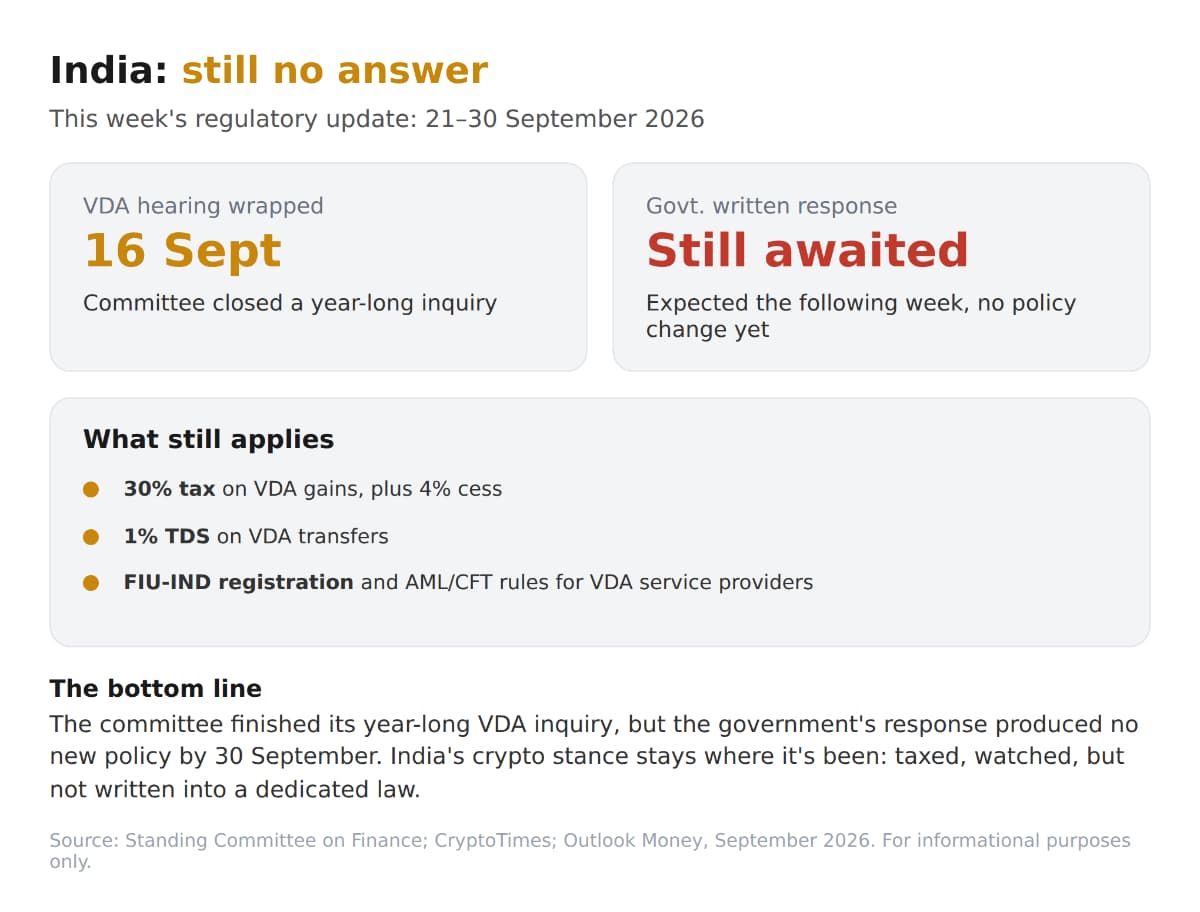
India's Standing Committee on Finance closed its VDA inquiry on 16 September. No new policy was announced by 30 September, so the 30% tax, 1% TDS, and FIU-IND rules still apply.
In the United States, agencies issued new crypto guidance and registrations, including CFTC and SEC FAQs and Coinbase Clearing’s CFTC registration, while the CLARITY Act remains pending.
The Fed proposed two GENIUS Act rules for stablecoin issuers, now open for 60 days of public comment.
The Eurosystem's Pontes platform went live, and the ECB began preparing to invest in tokenised securities. The MiCA review consultation closed on 30 September without amending MiCA yet.
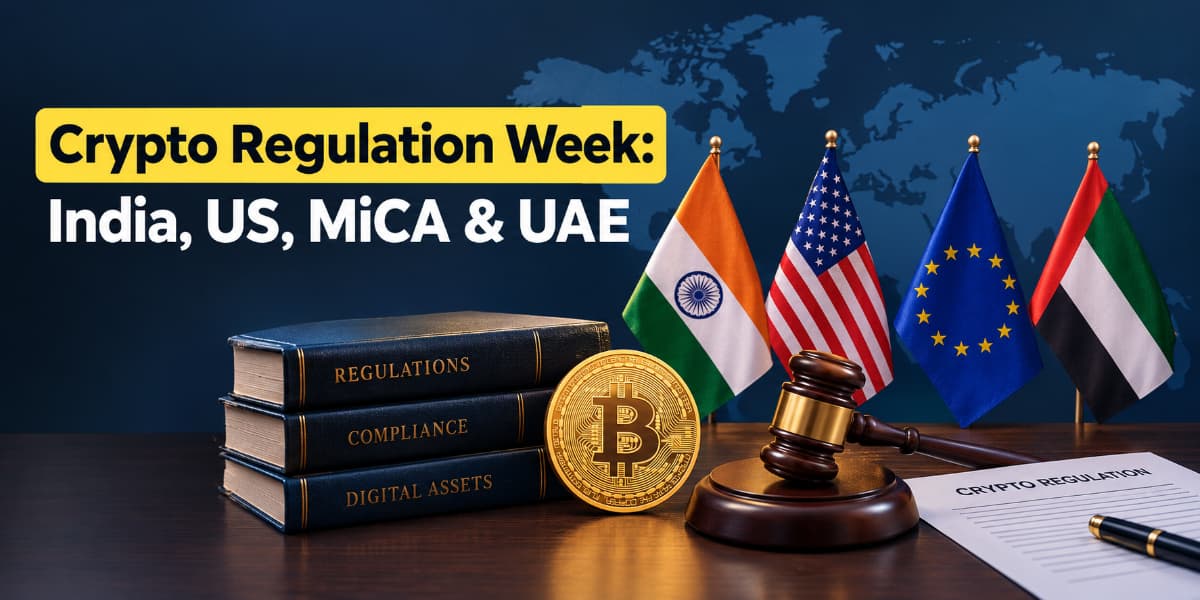
 Part of a series
In the last 10 days of September, the ECB began preparatory work to invest part of its own funds in tokenised securities. The NYSE and Blockchain.com signed an MOU to explore tokenised US-listed stocks and ETFs. In the US, regulators advanced crypto market and tokenisation guidance, and banks expanded their stablecoin payment infrastructure.
In Europe, the public consultation for the MiCA review closed. In the UAE, federal payment-token and virtual-asset rules continued to broaden the regulatory perimeter. India, meanwhile, ended the month with no new VDA legislation or regulatory framework.
The Standing Committee on Finance concluded its year-long inquiry into Virtual Digital Assets (VDAs) on 16 September, after hearing final evidence from the Department of Economic Affairs. Committee chair Bhartruhari Mahtab said the government was expected to submit its written response the following week to support the committee's final report.
From 21 to 30 September, that government response did not produce any new policy measure. No new legislation or regulatory framework was issued during this time to amend the VDA rules.
Consequently, the existing framework continues to govern the VDA ecosystem. This includes a 30% tax on VDA gains, 1% TDS on VDA transfers, and the obligation on VDA service providers to register with FIU-IND and implement AML/CFT controls. The committee's 16 September development is best treated as context for this week's update, not as a regulatory change within the 21 to 30 September window.
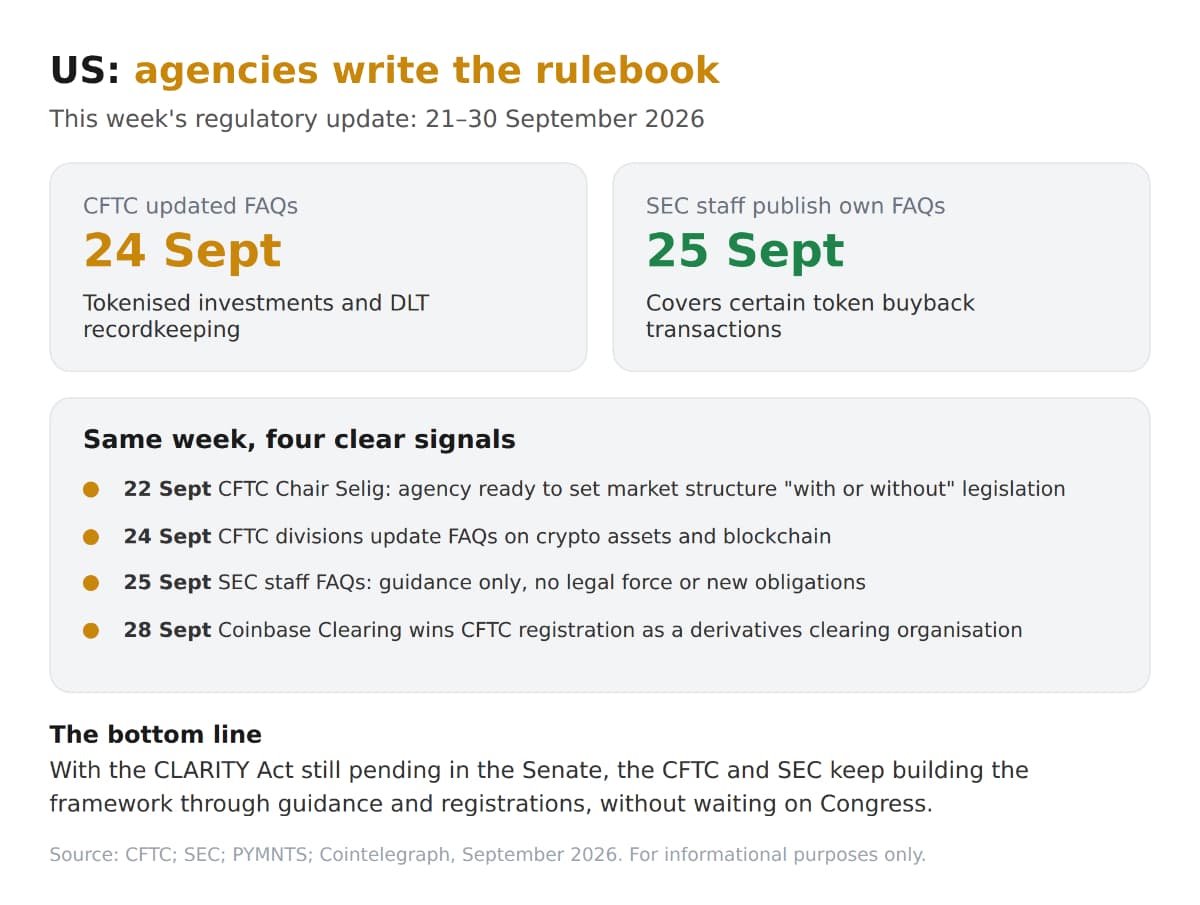
The CLARITY Act has not moved in the Senate, so US regulators are using their existing authorities to form crypto rules.
On 22 September, at the US Treasury Market Conference, Commodity Futures Trading Commission (CFTC) Chair Michael Selig said the agency was prepared to establish crypto market structure "with or without federal legislation". The CFTC has focused recently on tokenisation, the movement of collateral in financial markets, and market infrastructure.
On 24 September, the CFTC's Market Participants, Market Oversight, and Clearing and Risk divisions released updated frequently asked questions (FAQs) on crypto assets and blockchain technology. The FAQs cover permitted tokenised investments and blockchain-based recordkeeping for registered firms.
On 25 September, staff in the Securities and Exchange Commission's (SEC) Division of Corporation Finance also published crypto-asset FAQs, including positions on certain buyback transactions. This is staff guidance, not a Commission rule. The SEC states that the FAQs have no legal force and do not create new obligations.
On 28 September, Coinbase Clearing received CFTC registration as a derivatives clearing organisation, allowing it to clear fully collateralised futures, options on futures and swaps. The registration itself does not confirm that Coinbase may clear these products using USDC directly.
Overall, regulators continue to develop the crypto framework through agency guidance and registrations while the CLARITY Act remains pending.
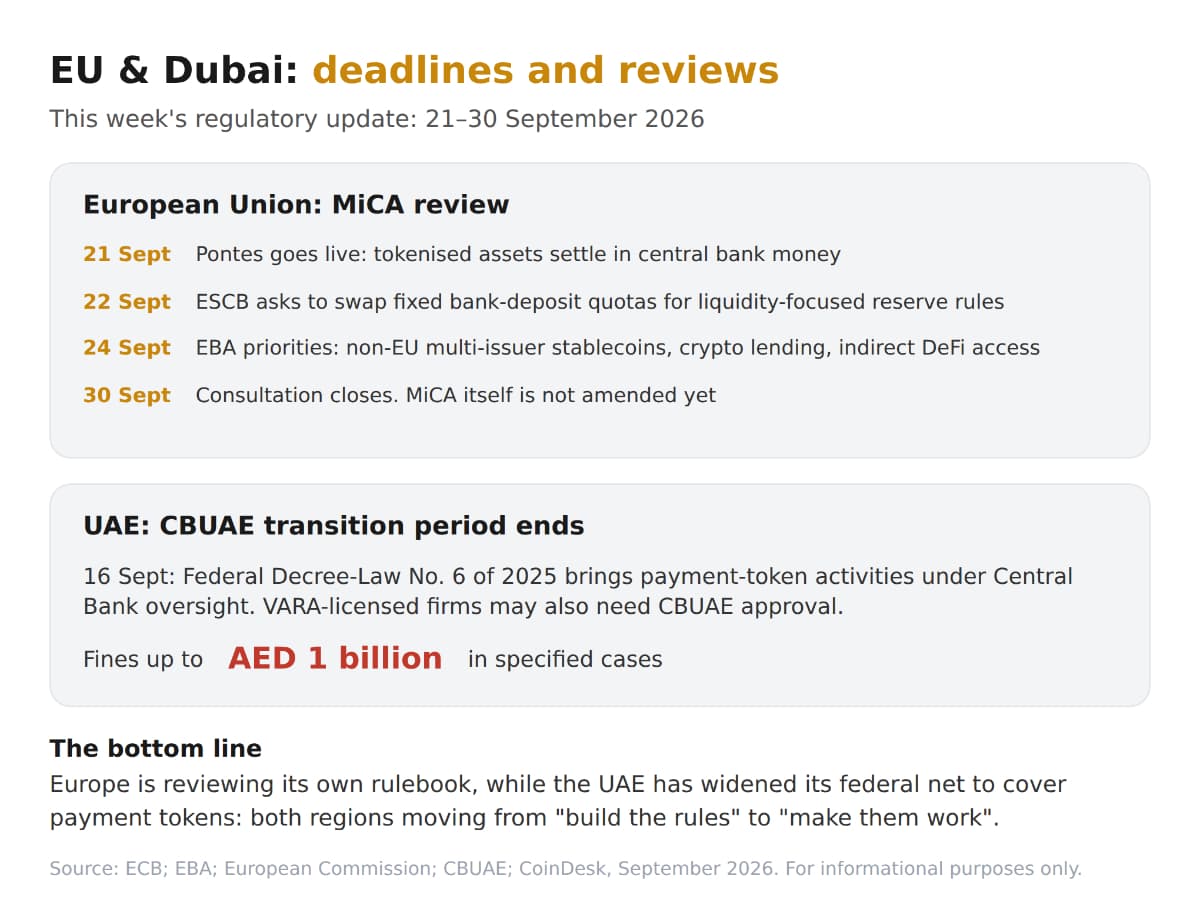
Pontes went live on 21 September. It is the Eurosystem's new wholesale DLT settlement platform, and it enables tokenised asset transactions to settle in central bank money.
On 22 September, the European System of Central Banks (ESCB), made up of the ECB and the 27 EU national central banks, called for changes to MiCA’s stablecoin reserve rules. In particular, the ESCB proposed replacing fixed bank-deposit quotas for certain large stablecoin issuers with liquidity-focused requirements, to ensure reserve assets can be converted into cash quickly.
On 24 September, the European Banking Authority (EBA) published its priorities for the MiCA review. These include stronger treatment of stablecoins issued through non-EU multi-issuer arrangements, and further consideration of crypto lending and activities that may provide indirect access to decentralised finance (DeFi).
Finally, on 30 September, the European Commission closed its public consultation. The deadline closes the consultation process. It does not itself amend MiCA. Any changes would require the subsequent EU legislative process.
Dubai's regulatory landscape should be viewed through both the Virtual Assets Regulatory Authority's (VARA) virtual-asset framework and the UAE federal Central Bank framework. The key September deadline came from Federal Decree-Law No. 6 of 2025.
Under Decree-Law No. 6, the Central Bank of the UAE (CBUAE) can now regulate payment-token activities and certain technology-enabled financial services. The law allowed a one-year reconciliation period, which ended on 16 September 2026.
This is not a VARA rule applying to all stablecoins or DeFi activity. VARA and the CBUAE have distinct regulatory mandates.
Penalties are severe. Administrative fines under the law can reach up to AED 1 billion in specified circumstances. Companies active in both regimes are more concerned about how the two systems will overlap. A company licensed under VARA may also need to meet CBUAE requirements, including non-objection or registration, where its activities fall within the federal payment-token perimeter.
So, the September development is better described as the UAE widening its federal regulatory perimeter than as a new standalone VARA rule.
Discussions about tokenisation have advanced from pilots to institutional market infrastructure.
On 21 September, the ECB announced preparatory work to invest a small portion of its own funds in tokenised euro-area public-sector and supranational securities, with settlement through Pontes. The ECB stated that this was to gain practical experience with tokenised settlement, custody and portfolio management. It is preparatory investment activity, not a completed large-scale bond-buying programme.
On 22 September, CFTC Chair Selig stated the market should prepare for 'mass tokenisation' and 24/7 trading. He highlighted the potential benefits for settlement and collateral mobility.
On 23 September, NYSE Group and Blockchain.com signed a memorandum of understanding to explore access to tokenised US-listed stocks and ETFs through the NYSE's planned digital trading venue. The initiative remains exploratory and subject to regulatory approvals.
Tokenised cash-management products, such as State Street and Galaxy's SWEEP, which launched earlier in 2026, also show the continuing growth of on-chain institutional infrastructure.
On 24 September, the Federal Reserve proposed two rules to implement the GENIUS Act for payment-stablecoin issuers and relevant bank subsidiaries under the Fed's supervision. The rules would set conditions relating to reserves, capital, and risk management, and would also establish a dedicated application process through which a bank could issue a payment stablecoin.
The rules are still proposed and are open to public comment for 60 days following their publication in the Federal Register.
On 28 September, Citi expanded its partnership with Coinbase, allowing its business customers to send and accept stablecoin payments. Coinbase handles the conversion, and Citi settles the fiat side as the regulated bank of record. Also on 28 September, Coinbase Clearing received CFTC registration as a derivatives clearing organisation.
Together, these developments show stablecoins and blockchain infrastructure integrating with conventional banking and regulated-market rails. By late September, the stablecoin market was worth about $306 billion and was dominated by USDT and USDC.
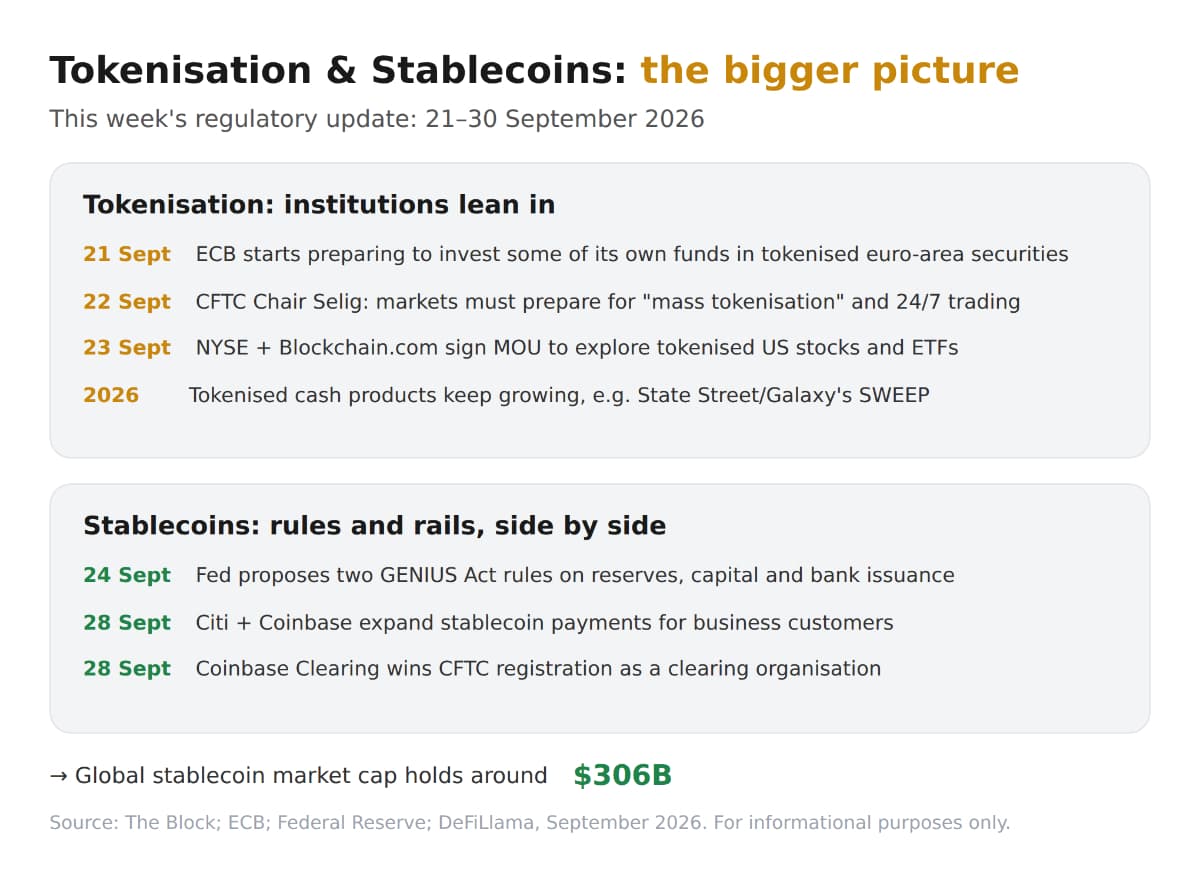
The developments of 21 to 30 September share a common theme: digital-asset infrastructure is increasingly being built through existing financial institutions and regulatory frameworks. In the US, agencies kept developing market structure, tokenisation and stablecoin rules while legislation remained pending. In Europe, the MiCA review reached a key consultation deadline, while the ECB advanced tokenised settlement and investment. In the UAE, federal and Dubai rules continued to define how virtual-asset and payment-token activities fit within the financial regulatory perimeter.
Tokenisation and stablecoins have moved from the sandbox and pilot phases into more mainstream regulatory frameworks. India has still not released its long-awaited framework, so it's important to understand the difference between an announced policy change and a regulatory response that is still awaited.
Sources: CFTC; US Securities and Exchange Commission; Federal Reserve; European Central Bank; European Banking Authority; European Commission; CBUAE; VARA; NYSE; Blockchain.com; Citi; Reuters; CoinDesk; The Block; DeFiLlama. Data as of 30 September 2026. All regulatory statements should be checked against the relevant official source before being relied upon.
India Crypto Research operates independently. The information presented herein is intended solely for educational and informational purposes and should not be construed as financial advice. Before making any financial decisions, it's essential to undertake your own thorough research and analysis. If you're uncertain about any financial matters, we strongly recommend seeking guidance from an impartial financial advisor.