
This week in one minute
Why does it matter that Bitcoin is back above its cost basis?
Where is the new money and buying for this current rally?
Bitcoin unfazed by interest rate hike
Holders are calm, not greedy
Miners keep adding power
Leverage is neutral ahead of a big expiry.
Where are the key levels?
What this means for Indian readers
What is yet to occur
FAQs

Bitcoin closed the week at $81,159 (about ₹77.8 lakh), above the average purchase price of every major group of holders.
The U.S. Federal Reserve increased interest rates for the first time since 2023. Bitcoin increased through the decision.
New money played no part in the recent surge of Bitcoin, with spot ETFs taking in just $6.2 million.
There is no urge among investors to sell Bitcoin.
A $14.4 billion options expiry on 25 September has its max pain at $72,000, about 11% below the price.

In the span of 2 days, Bitcoin took 2 major hits. First, the U.S. Senate voted down the CLARITY Act on the 15th. Just over 24 hours later, the Fed raised its target range by 0.25 percentage points. Bitcoin dropped to $74,945, and by the end of the week it bounced 8% to $81,159.
The price came back, but the buyers were not to be found this week.
This one-minute snapshot covers the important Bitcoin price action this week.
1. Price is back above cost basis. The cost basis is the price at which an investor purchased an asset. For most, the cost basis is below this week's closing price. This means that, on average, Bitcoin investors are in profit and are less likely to sell.
2. The Fed hiked to a 3.75% to 4.00% range. The Fed's latest rate hike means the cost of borrowing increased for everyone, including the funds that buy Bitcoin.
3. ETF demand stalled at $6.2 million. Demand for spot Bitcoin ETFs fell this week. The biggest buyer of the past two years sat this rally out.
4. Miners added more computing power. Continued investment in Bitcoin mining created further improvements to network security. Fees, on average, remain close to zero.
5. A record options expiry lands on Friday. Positions clustered near $72,000 could pull on the price or add volatility.
Bitcoin being above cost basis is bullish for the market. Every major group of Bitcoin holders is back in profit.
The True Market Mean is $78,337. This is what active investors paid on average for the Bitcoin they still hold. It is adjusted to not include stale or lost coins.
The short-term cost basis is $71,295. This is what investors on average paid for coins that were purchased 155 days or less prior to the date in question. In general, these coins are sold before others during a downtrend.
The cost basis for corporate treasuries is approximately $80,500. This is the average entry price of listed companies holding Bitcoin on their balance sheets, as last reported by Glassnode.
Bitcoin closed above all three means. Last week Glassnode reported that Bitcoin was trading below its version of the True Market Mean. That break didn't hold.
People with unrealised profits are less inclined to sell, especially the moment the price returns to their cost basis. The nearest mean to Bitcoin's price is the cost basis for corporate treasuries at approximately $80,500, about 1% below the price. Those companies had been underwater on their Bitcoin since January.
The chart below maps the levels that matter now. Support sits in green, resistance in red.
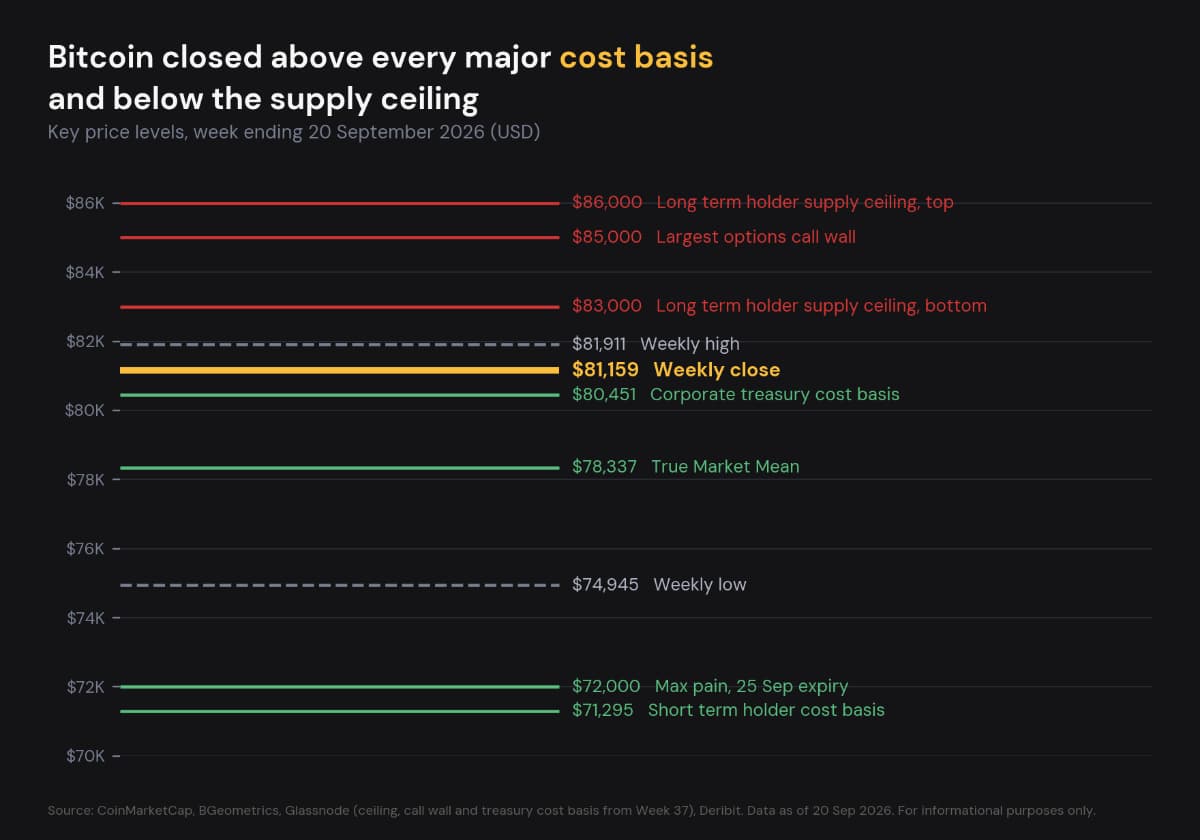
Key Bitcoin price levels for the week ending 20 September 2026
Snapshot - Short-term holder cost basis $71,295 (flat against $71,300 last week). True Market Mean $78,337 (first reading from our data provider, so no weekly change yet).
What this means for readers: Support now sits just below the price, between $80,500 and $78,300. A weekly close under $78,300 would put the next cushion at $71,300 to $72,000, roughly 11% lower.
The rally happened without new money.
Bitcoin spot ETFs let investors hold Bitcoin through conventional brokers. Between the 14th and 18th of this month, these ETFs saw net inflows of $6.2 million. This is the lowest weekly inflow since the ETFs started trading. The previous week, these ETFs saw a net outflow of $462.7 million. Hence, the selling pressure has abated. Buying pressure has not returned.
Currently, the market cap of all stablecoins is $311.6 billion. Bitcoin's Realised Cap is currently $1.072 trillion. Realised Cap increases when new money enters the Bitcoin network.
There is still outflow from exchanges. On 22 September, the total Bitcoin holdings of all exchanges was 2.707 million. At the beginning of 2026, this figure was about 3.1 million. On the 20th of this month, a net 439 Bitcoin moved back onto exchanges, a small inflow against that long decline.
Coins held in private wallets are harder to sell in a hurry.
Snapshot - Spot ETF net flows plus $6.2 million (against outflows of $462.7 million the prior week). Exchange balance 2.707 million BTC.
What this means for readers: Recently, there have not been significant inflows into the spot Bitcoin ETFs. Current data suggests that holders are not selling. A return of significant inflows into these ETFs will confirm the return of new buyers in the market.
The Fed announced an interest rate hike bringing the target range to 3.75% to 4.00% on September 16. Core inflation for the US was reported at 2.4%, bringing the real rate to 1.60% from 1.35%. With inflation adjustment, this depicts a tighter monetary policy. The 10-year Treasury yield closed at 5.01% for the week.
What this means for readers: Tighter money is a headwind for new flows into risk-on assets. That fits the weak ETF numbers, even as Bitcoin held up.
MVRV is at 1.52, meaning the market is valued 52% above the average cost of holders. NUPL is at 0.34, meaning roughly a third of Bitcoin's market value is paper profit. SOPR averaged 1.002, so coins that moved this week sold at about breakeven. In all, 72% of the supply is in profit.
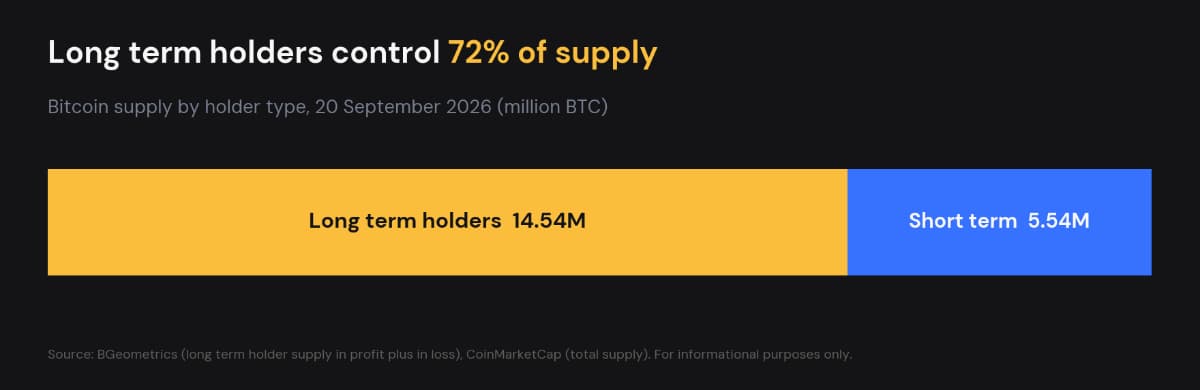
Bitcoin supply split between long-term and short-term holders
What this means for readers: These readings sit mid-range, far from the levels seen near past cycle peaks. Holders are neither taking large profits nor capitulating.
The average hash rate was 928 EH/s for the week. Mining difficulty was up 4.17% for the week. Only about 0.6% of the weekly mining revenue of $252.1 million came from transaction fees. The network averaged 440,220 active addresses and 707,449 transactions a day.
What this means for readers: The network is busy but not congested, and miners still rely almost entirely on the fixed reward for each new block.
The Bitcoin funding rate is a periodic payment between buyers and sellers of perpetual futures. This week, the rate was positive, which means the longs were paying the rate, and the rate was 0.0069% every 8 hours. This rate is normally at 0.01%, so borrowing money was not the main factor in this move.
The total value of all open Bitcoin futures contracts is 710,220 BTC, worth $61.3 billion. Longs were liquidated to the tune of $133.7 million, and shorts to the tune of $152.9 million.
The increasing price means more shorts were liquidated, which makes sense with the data set.
Open interest at OKX, one large venue, increased by 14% over the last 30 days, with most of the increase occurring after the 17th of this month.
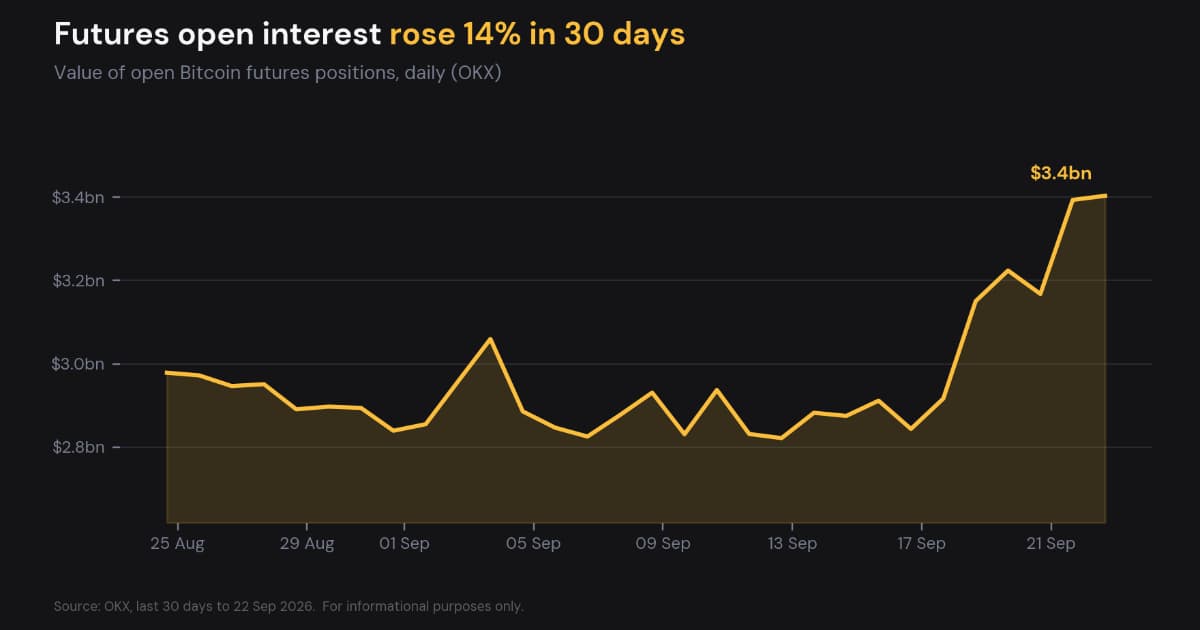
Bitcoin futures open interest over the last 30 days
The funding rate has been positive but thin for the month of September. It has dipped below the 0 line only once, on the 5th, and touched the neutral baseline on a few other occasions.
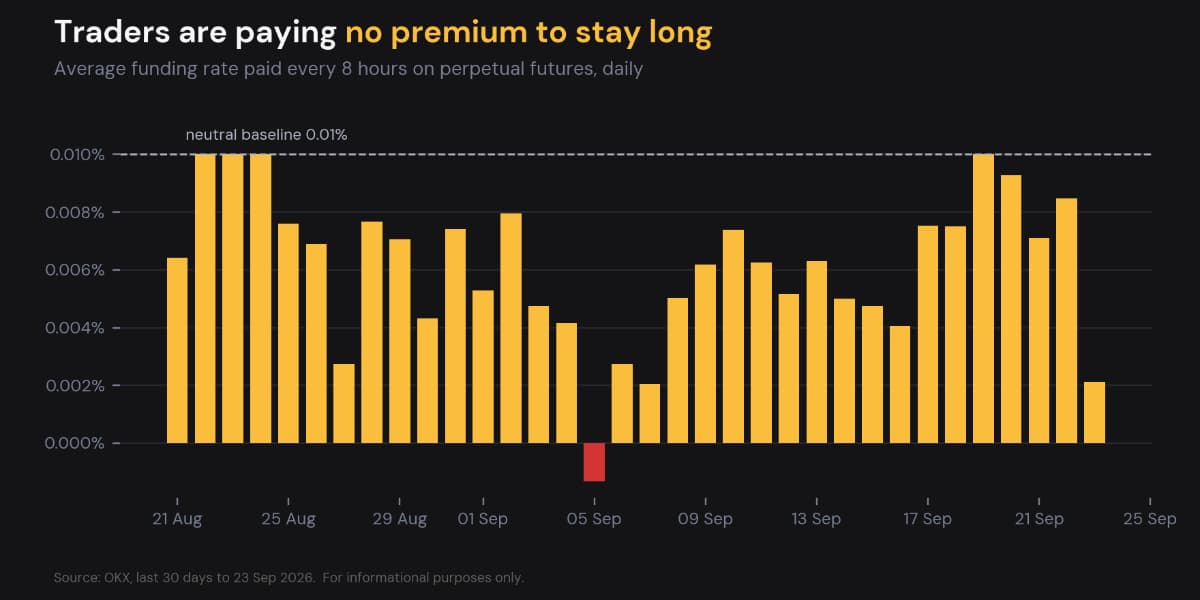
Bitcoin perpetual futures funding rate over the last 30 days
On the 25th of September, around $14.4 billion worth of Bitcoin options will expire, the largest expiry of the year. The price of max pain, the price at which the most options will expire worthless, is $72,000. One-week implied volatility is a calm 36.9%. Currently, calls cost slightly more than puts, a mild shift towards optimism since the Senate vote.
The heaviest block of calls and the heaviest block of puts both sit around the $70,000 price level, well under the market. As of the 23rd, max pain had drifted up to around $75,000, still below spot.
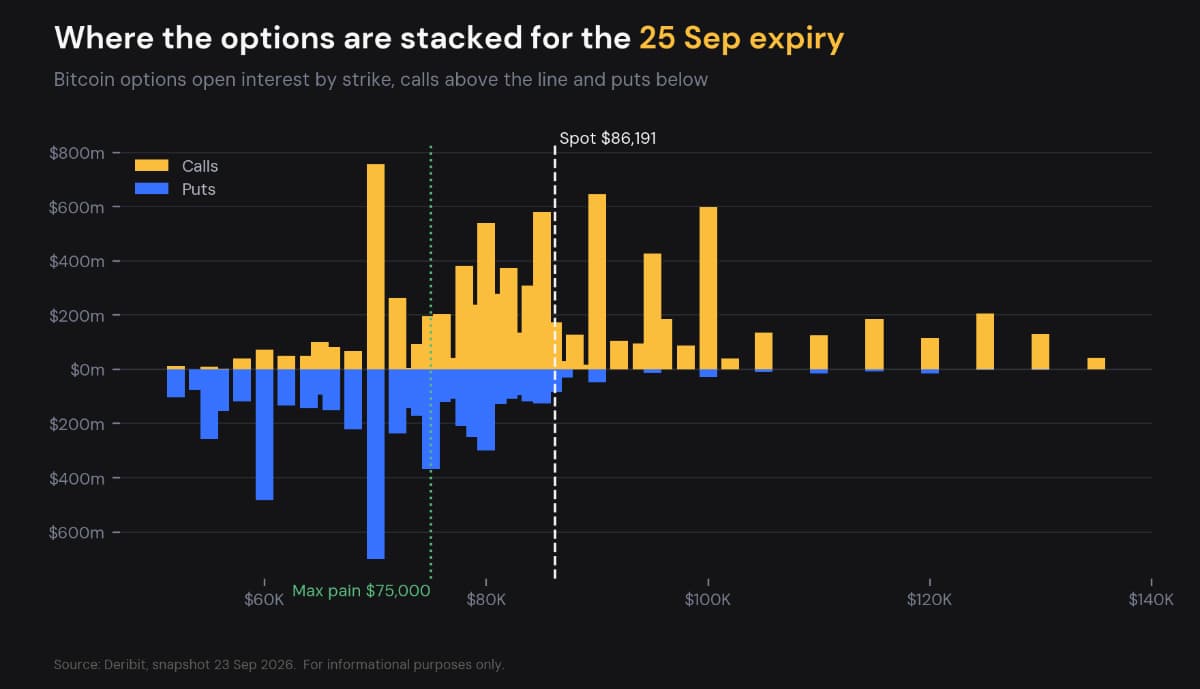
Bitcoin options open interest by strike for the 25 September expiry
Snapshot -Futures open interest $61.3 billion. Weekly liquidations $133.7 million long and $152.9 million short.
What this means for readers: Neither side is over-extended, so a sharp move is unlikely to set off a run of forced selling. Expect the options market to pull on the price into Friday, and volatility once the expiry passes.
| Level | Price | Why it matters |
|---|---|---|
| Resistance | $83,000 to $86,000 | Long-term holder supply ceiling and the $85,000 call wall |
| Weekly high | $81,911 | A close above opens a test of the ceiling |
| Weekly close | $81,159 | |
| Support 1 | $80,451 | Corporate treasury cost basis |
| Support 2 | $78,337 | True Market Mean |
| Support 3 | $71,295 to $72,000 | Short-term holder cost basis and max pain |
| Scenario | Trigger | Next level |
|---|---|---|
| Bull case | Weekly close above $81,911 with ETF inflows returning | $83,000 to $86,000 |
| Base case | Price holds between $78,300 and $83,000, flows stay flat | Range into the 25 September expiry |
| Bear case | Weekly close back under $78,337 | $71,300 to $72,000 |
In Indian rupees, Bitcoin closed the week at about ₹77.8 lakh, using a midweek rate of around ₹95.9 to the US dollar. The rupee moved between ₹95.68 and ₹96.11 during the week. So, even without any change in the US dollar price of Bitcoin, the rupee price could fluctuate.
Gains on Virtual Digital Assets (cryptocurrencies, crypto tokens and NFTs) are subject to a flat 30% tax in India, in addition to a 4% health and education cess. Moreover, 1% TDS is also applied on these transfers. Under the Income-tax Act, 1961, these rules sit in Section 115BBH and Section 194S. Losses are not allowed to be offset against gains.
Budget 2026 did not change these provisions. The new Income-tax Act, 2025 governs transactions from 1 April 2026.
In practice: buy at ₹75 lakh, sell at ₹78 lakh, and you owe ₹90,000 (30% of the ₹3 lakh gain) plus cess. The exchange also withholds ₹78,000 as TDS at the sale, which counts towards your final tax.
Corporate treasury purchases and an updated treasury cost basis are not in this issue. Glassnode, the only source for the treasury average entry, had not published its Week 38 report at the time of writing. As of Glassnode's last report, the corporate treasury average purchase price was approximately $80,500, about 1% under this week's close.
Sources and dates. Price, market cap and dominance from CoinMarketCap (daily closes, 14 to 20 September 2026). Network activity, fees and miner revenue from Token Terminal. Cost basis, holder supply, SOPR and Realised Cap from BGeometrics (20 September). Hash rate and difficulty from mempool.space. ETF flows from SoSoValue via The Block (14 to 18 September). Macro from the Federal Reserve, FRED and Yahoo Finance. Options from Deribit, futures open interest from CoinGlass, exchange balances from CryptoQuant (all read 22 September). Funding from OKX. Treasury cost basis, supply ceiling and call wall from Glassnode Week On-chain, Week 37. Rupee rates from Wise.
India Crypto Research operates independently. The information presented herein is intended solely for educational and informational purposes and should not be construed as financial advice. Before making any financial decisions, it's essential to undertake your own thorough research and analysis. If you're uncertain about any financial matters, we strongly recommend seeking guidance from an impartial financial advisor.


