
1. What Is Bitcoin Mining?
2. Why Bitcoin Mining Is Important
3. The Bitcoin Mining Process
4. The Journey of Bitcoin Mining
5. Earning Potential of Bitcoin Miners
6. Bitcoin's Path to 21 Million
7. How Many Bitcoins Have Been Created?
8. The Future of Bitcoin Mining
Conclusion
FAQs

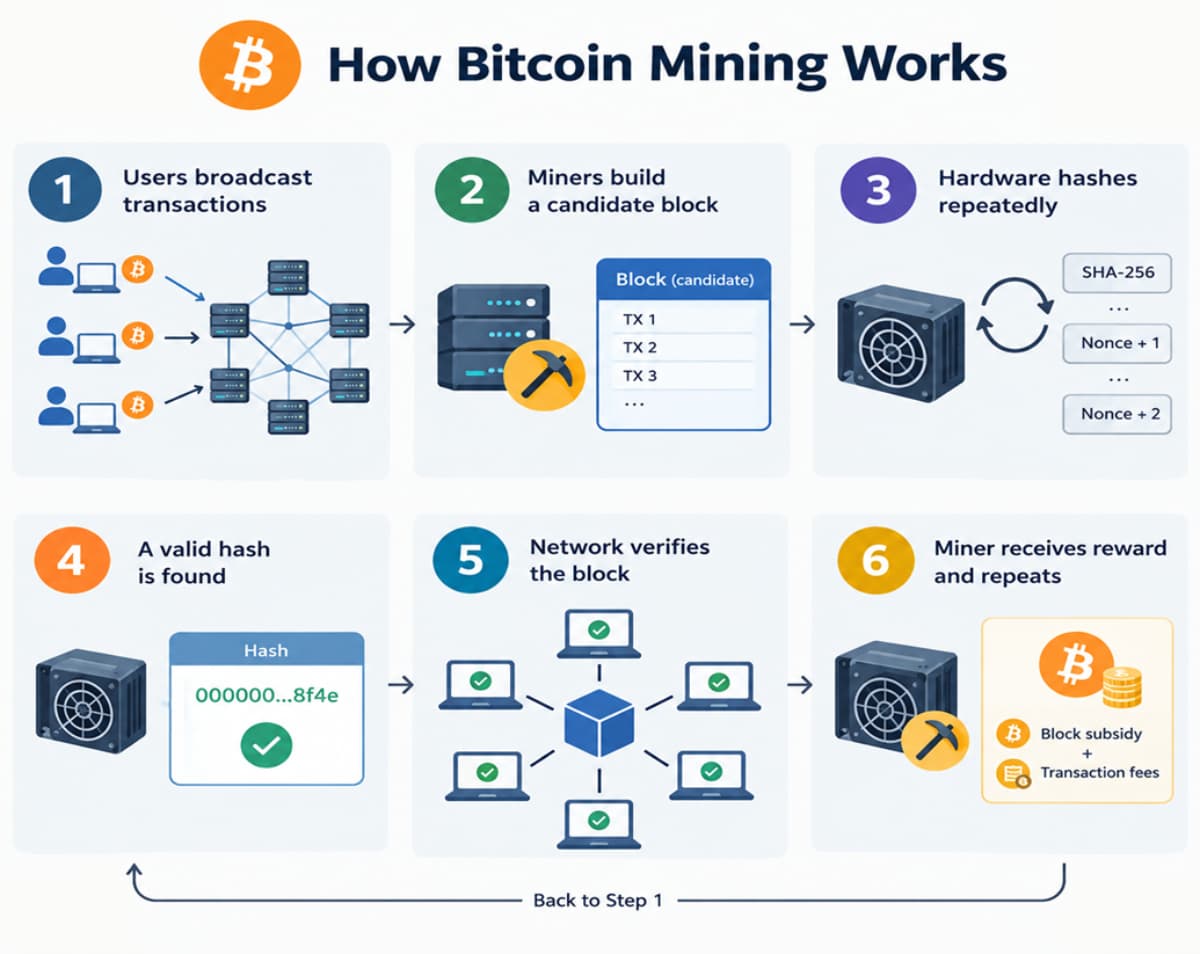
When new bitcoins need to be generated and previous transactions need to be added to the blockchain, Bitcoin mining is performed. Bitcoin mining uses a consensus mechanism called Proof of Work. In order to add a block of transactions to the blockchain, a process called hashing needs to take place. The mining hardware attempts to find a valid hash, one that falls below the network's difficulty target, by computing the hash function for the block over and over again. The hash function includes various parameters of the block, such as the previous block's hash, a timestamp, the nonce, and a summary of the transactions contained in the block.
The first miner to find a valid hash broadcasts the block to the network. Other nodes on the network verify the block and its transactions. If the block is valid, it is permanently added to the blockchain, and the miner that added the block to the blockchain is rewarded.
Bitcoin does not have a central bank. Transactions on the Bitcoin network are verified and added to the blockchain by the mining process.
While the Bitcoin network processes transactions, new bitcoins are generated and added to circulation by the mining process. The Bitcoin network ensures that generating new blocks and adding them to the blockchain is difficult. Bitcoin mining makes changing previously created and verified blocks extremely difficult and costly. Bitcoin mining ensures that the Bitcoin network is secure.
Step 1: Transactions are created and signed by users. The signed transactions are shared on the Bitcoin network.
Step 2: Mining hardware creates candidate blocks by combining valid transactions.
Step 3: SHA-256 hashing is performed over and over, changing values such as the nonce each time.
Step 4: A miner finds a hash below the network's required target.
Step 5: Other nodes validate the new block according to the consensus rules.
Step 6: The block is added to the chain, and the successful miner receives the block subsidy and transaction fees.
In the beginning, Bitcoin mining was simple and easy. In fact, it was possible to mine Bitcoin with a regular personal computer. Eventually, it was no longer profitable to mine Bitcoin with a personal computer, and people moved to GPUs, then FPGAs, and finally specialised hardware.
Hardware that is specifically designed to mine Bitcoin is called an Application-Specific Integrated Circuit (ASIC) Miner. Mining with an ASIC was so energy efficient that it changed Bitcoin mining from a hobby to a large-scale business.
Mining businesses spend a significant amount of money to purchase mining hardware and then spend additional money to operate the hardware. The operating costs include electricity, cooling,g and maintenance. If the hardware is not running continuously, the business loses revenue.
| Period | Major Development |
|---|---|
| 2009 | Bitcoin launches; CPU mining begins |
| 2010–2011 | GPU mining becomes popular |
| 2011–2013 | FPGA hardware gains adoption |
| 2013 onward | ASIC machines become dominant |
| 2019 | Cambridge launches CBECI for Bitcoin electricity estimates |
| 2021 | Major geographic migration follows Chinese mining restrictions |
| 2024 | Bitcoin halving reduces block subsidy to 3.125 BTC |
| 2025–2026 | Research increasingly focuses on environmental impacts, energy integration, and long-term mining economics. |
Mining Bitcoin is competitive. There are two ways to gain profit from Bitcoin mining. One way is to gain Bitcoin from mining a block. The other way is to gain profits from fees that users pay to include their transactions in a block. Fees become a bigger part of miner income when demand for block space is high.
The last block reward reduction occurred in April 2024. Since then, each block reward has contained 3.125 BTC. The block reward is cut by 50% every 210,000 blocks, roughly every four years, and will keep decreasing until the maximum supply of 21 million Bitcoins is reached.
Since its creation, Bitcoin has had block rewards of 50, 25, 12.5, 6.25, and most recently 3.125. Block rewards are cut in half every 210,000 blocks and will continue to do so until around 2140.
Due to block rewards being cut in half, miners are required to have more efficient machines, cheaper power, or be part of a larger mining operation in order to mine bitcoin at a profit.
After a certain point, the creation of new bitcoin will come to a stop. The mining reward will continue to decline until the 21 millionth and final bitcoin is mined.
The fees that users pay to process transactions will then need to cover the cost of the work done by miners.
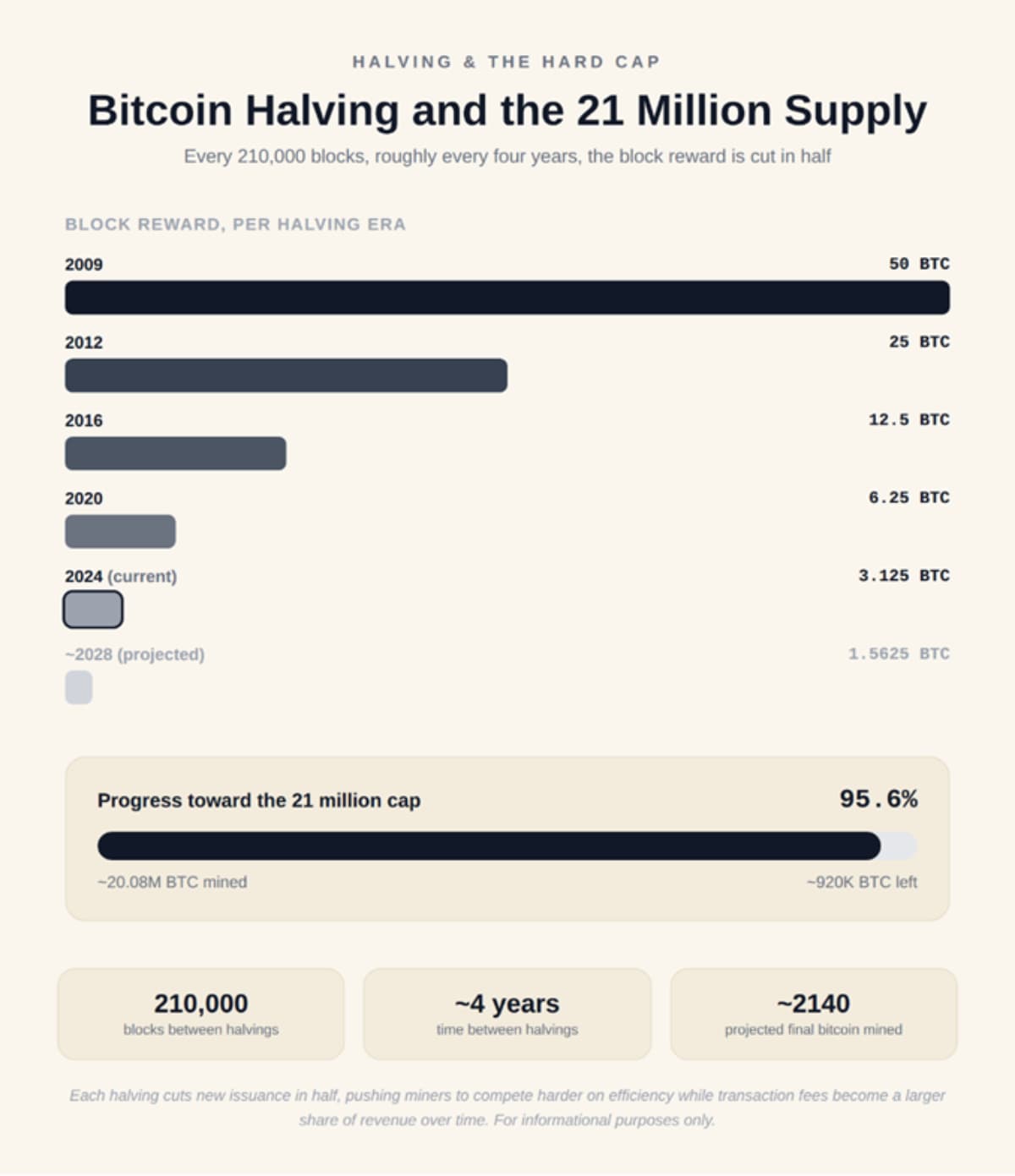
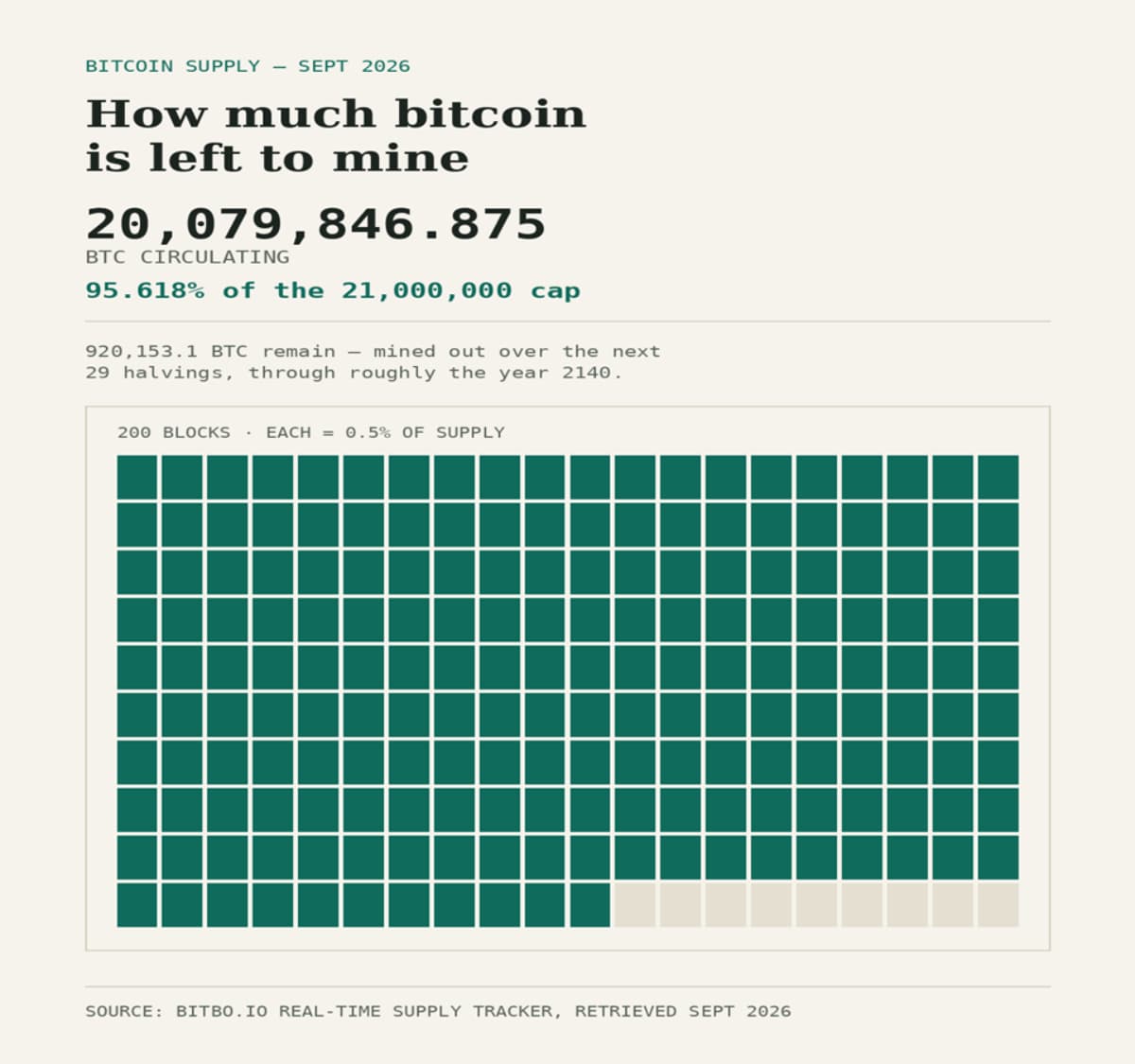
Over 20 million bitcoins have been created and are in circulation. This means that 95.6% of the maximum supply has been created.
The roughly 920,000 remaining bitcoins will take more than 110 years to create. They will be released slowly over the next 29 halvings, until around 2140.
There will be greater specialisation of mining hardware, integration of energy and mining facilities, entry of large financial institutions into the mining industry, and the decrease of the reward for mining Bitcoin. The shift from block reward to transaction fees is one of the biggest open questions for Bitcoin's long-term security.
Mining companies are already diversifying. Many are using their existing power setups to move into data centres and high-performance computing.
Mining bitcoin has changed from using the processing power of a personal computer to the specialised hardware and facilities of large-scale operations.
The question is, can bitcoin miners continue to make a profit and validate the bitcoin transactions without the block rewards? I predict the average transaction fee will rise as adoption grows, making up for the lost block rewards.
Sources: Cambridge Bitcoin Electricity Consumption Index (CBECI), Cambridge Judge Business School (2023), Nature Communications (2025), Scientific Reports (2025), Bitbo.io supply tracker (September 2026), Bitcoin protocol documentation.
India Crypto Research operates independently. The information presented herein is intended solely for educational and informational purposes and should not be construed as financial advice. Before making any financial decisions, it's essential to undertake your own thorough research and analysis. If you're uncertain about any financial matters, we strongly recommend seeking guidance from an impartial financial advisor.


